The future of filmmaking is less about machines replacing crews and more about economics and formats shifting around them. The cost of ambitious imagery is falling, stories now need to exist in several shapes and on more distribution routes, and the rules on AI and authorship are being written right now. Story, performance and craft judgment are not changing.
Predictions about the future of film tend to be either breathless or dismissive. The useful version sits between: some things are changing structurally, some at the margins, and some not at all. Here is a grounded read on each, and what studios, producers and content owners can do about it this year.
Key takeaways
- The cost floor for ambitious imagery is falling, which mostly helps low- and mid-budget productions rather than threatening the largest ones.
- Format fragmentation and multiplying distribution routes are the genuinely structural changes for rights holders.
- Guilds, the Academy and the U.S. Copyright Office have all put human authorship at the center of their AI rules.
- Young audiences have not abandoned cinemas: Cinema United reports Gen Z moviegoing frequency rose 25% over the 12 months to its December 2025 update.
- Story, performance and creative judgment remain the work; AI tools generate options, and people still choose.
- Clean rights, deliverable masters and good metadata pay off under almost every version of the future.
Table of contents
- What is genuinely changing in the future of filmmaking
- The rules for AI in film are being written now
- Is Gen Z going to the movies?
- What is changing at the margins
- Will filmmaking be replaced by AI?
- The questions that are still open
- What to do in the next twelve months
- How to tell real change from noise
- Building for whatever comes next
- Frequently asked questions
What is genuinely changing in the future of filmmaking
Five shifts are structural rather than cosmetic. Each changes the economics for a working producer, not just what a demo can do.
- The cost floor for ambitious imagery is falling. Sequences that once needed a large visual effects budget are becoming achievable for far less. That does not put big productions out of business; it puts ambitious imagery within reach of productions that previously could not consider it.
- Iteration is becoming affordable. Exploring ten approaches to a sequence in pre-production used to be impractical. When rough versions cost minutes, exploration replaces commitment by default, and decisions get pressure-tested before money is spent.
- Format is fragmenting. For most of cinema’s history there was one shape. Now there are several surfaces with different grammars: theatrical, television, and vertical formats with their own structure and economics. Our vertical video strategy guide for studios covers that shift in detail.
- Distribution is multiplying. FAST channels, direct-to-audience apps, vertical services and licensing marketplaces have widened a path that used to be narrow and gatekept.
- Catalog value is being reassessed. Libraries written down as dormant can earn again through ad-supported channels and format conversion, as we explain in how to monetize a legacy video library with AI.
Key insight: The future of the film industry rewards whoever controls content people want and has it in a state that can move quickly. More formats and more routes both make the underlying asset more valuable, not less.
The rules for AI in film are being written now
The biggest near-term change may be institutional rather than technical: the bodies that govern credit, awards and ownership have started to define where AI fits, and each has put human authorship at the center.
| Body | What it has said | What it means for producers |
|---|---|---|
| Writers Guild of America | Under its 2023 contract, AI is not a writer, AI-generated material is not literary or source material, and companies cannot require writers to use AI | AI can support a writers’ room, but AI material cannot be used to undercut writers’ credit or compensation |
| Academy of Motion Picture Arts and Sciences | Screenplays must be human-authored and performances demonstrably performed by humans with consent to be eligible | Keep records of AI use if an awards run is part of the plan |
| U.S. Copyright Office | AI tools that assist human creativity do not affect copyright; purely AI-generated material is not protected | Human authorship determines what you own, so document it |
The WGA’s summary of its 2023 AI provisions is direct: neither traditional nor generative AI is a writer, a company must disclose to a writer if materials it hands over were generated by AI, and the guild reserves the right to argue that training AI on writers’ material is prohibited. For awards, TechCrunch reports that the Academy’s new rules require performances “demonstrably performed by humans with their consent” and human-authored screenplays, and that the Academy may ask for documentation of AI use. On ownership, the Copyright Office’s January 2025 report concludes that “the use of AI tools to assist rather than stand in for human creativity does not affect the availability of copyright protection,” while purely AI-generated material is not protected.
Put together, these rules point in one direction. The future of cinema they describe is one where AI is a tool in the hands of credited people, not a substitute for them.
Is Gen Z going to the movies?
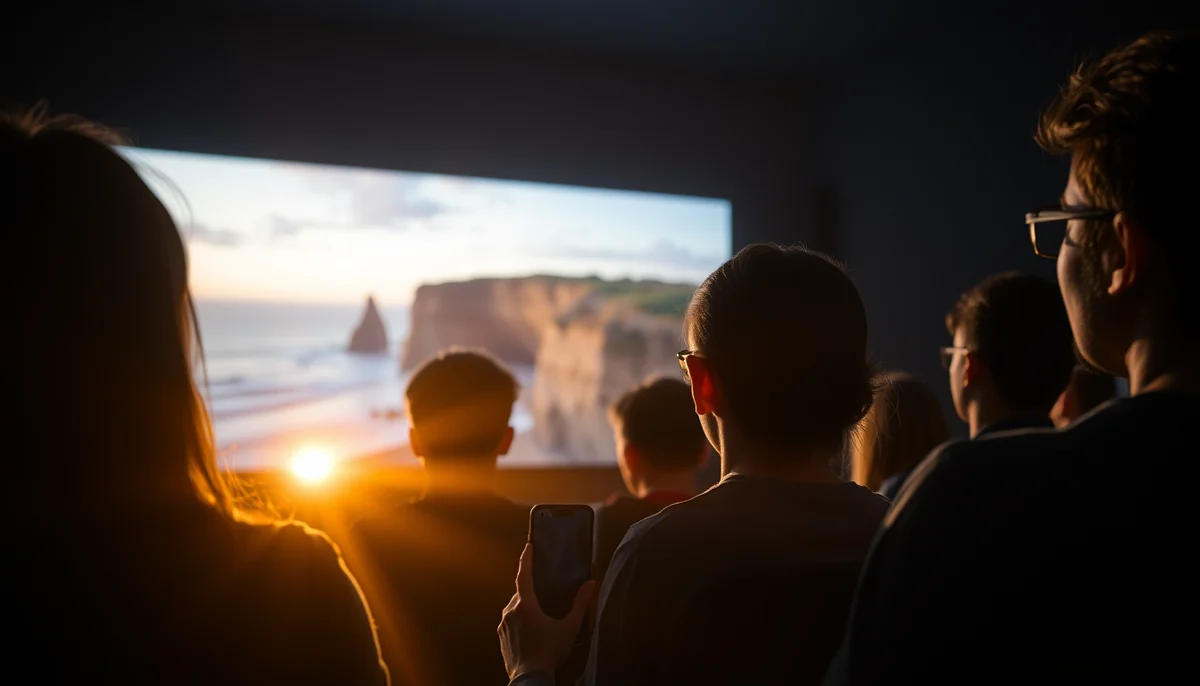
Yes, and more often than recently. Cinema United’s December 2025 update reports that Gen Z moviegoers’ frequency of attendance grew by 25% over the previous 12 months, with average visits rising to 6.1 from 4.9, and that “77% of Americans aged 12-74 saw at least one movie.” It also reports that 41% of Gen Z audiences went six times or more, up from 31% in 2022.
Many of the same viewers also watch short-form and vertical video on their phones. The lesson for the future of movies is not that one screen wins. It is that the same story may need a theatrical version, a streaming version and vertical material that reaches people where they scroll, all planned from the start.
What is changing at the margins
Some shifts in the future of filmmaking are real but gradual, and planning as if they were sudden is its own mistake.
- Post-production timelines. Compressing, not collapsing. Review, approval and iteration still take the time they take.
- Crew composition. Shifting rather than shrinking. New specialties appear around real-time engines, AI supervision and data management, while the core disciplines persist.
- Where the money is made. Slowly moving from a few large release windows toward more numerous, smaller and longer-lived revenue streams across platforms and formats.
For independents and mid-sized producers, these gradual shifts add up to more options rather than fewer. A project that once had one route to market, and one budget ceiling set by what visual effects cost, can now plan for several versions and several outlets from the first draft. That is a planning change more than a technology change, and it is available to anyone willing to think about deliverables before the shoot.
Will filmmaking be replaced by AI?
No. AI is changing how parts of films are planned, made and versioned, but the core of filmmaking is judgment about story and performance, and that does not transfer to a tool. Being firm about this matters, because most overclaiming happens here.
- Story. No production technology has ever made a bad script work, and none of the current ones do either.
- Performance. What an actor does remains what audiences respond to. The Academy’s new eligibility rules reflect the same view.
- Craft judgment. Deciding what a shot is about, where to cut and what to withhold is the work. Tools generate options; someone still chooses.
- The economics of attention. Audiences have finite time and endless choice, and no production method changes that.
- Rights and relationships. The business still runs on who controls what and who trusts whom.
The productions doing good work with AI are the ones where experienced people direct the tools. That is the model we build for, and it is the practical answer to whether filmmaking has a future: it does. The future of filmmaking has more tools in it and the same fundamentals underneath.
The questions that are still open
Three issues are genuinely unresolved and deserve to be stated rather than smoothed over.
- Provenance and consent. What generative tools were trained on, and whether the people whose work trained them agreed, is still unsettled legally and ethically. Productions using these tools carry real exposure and should document their choices.
- Labor. The effect on working crew is real and contested, and it is not resolved by saying new roles will appear. Some will, but the transition is not costless for the people in it. The guild agreements above are one way the industry is managing it.
- Homogenization. Tools trained on existing work tend toward the average of that work. Whether wide adoption produces more distinctive filmmaking or less is an open question, and the honest answer is that nobody knows yet.
What to do in the next twelve months
A list of moves that pay off under most plausible versions of the future of filmmaking is more useful than another prediction. None of these depends on betting on a single tool.
- Complete a rights audit of your catalog. Licensing, FAST, conversion and direct distribution all depend on knowing what you control.
- Get materials into a deliverable state. Masters located, digitized where needed, transcoded to a house standard and checked. A catalog that cannot be delivered cannot be monetized.
- Rebuild metadata. Content nobody can find earns nothing, wherever it is distributed.
- Run one format experiment. Convert a small set of titles for vertical platforms, or launch a themed channel. The goal is evidence about your own material, not a strategic commitment.
- Adopt AI where the output is provisional. Previs, storyboards, concepting and scheduling, measured by setups and shooting days rather than tool adoption.
- Write an AI and provenance policy. Decide which tools may be used on what material, what gets documented and what gets disclosed, before a distributor or awards body asks.
- Do not restructure around a single platform. Vertical and FAST services are still consolidating, so optionality is worth more than optimization.
How to tell real change from noise
One test separates durable shifts from hype: does it change the economics for a working producer, or does it only change a demo? Falling costs for ambitious imagery change economics, because producers can now attempt sequences they could not afford. Format fragmentation changes economics, because content needs more shapes and each shape is a new revenue route.
A tool that produces impressive isolated shots but cannot hold characters and environments consistent across a sequence changes a demo. It will change economics when consistency is solved, and not before.
Key insight: When you read a claim about the future of filmmaking, ask who it saves money for and on which part of the pipeline. If nobody can answer, it is a demo, not a trend.
Building for whatever comes next
The organizations that do well as the future of filmmaking unfolds are unlikely to be the ones that picked the right tool. They will be the ones whose rights are clean, whose materials are ready and whose stories can move quickly to wherever the audience turns out to be. For a practical view of where AI fits in a full production today, read our guide to making a complete film with AI.
CineVision builds for that future across the lifecycle. Big Idea supports AI-assisted production from script to storyboard, pre-viz and render with artists in control, ReFrame converts finished masters into new aspect ratios, and Tall Tale gives content owners their own branded vertical streaming app and FAST channel. Start with the part of the pipeline where your next project needs the most help.