Introduction
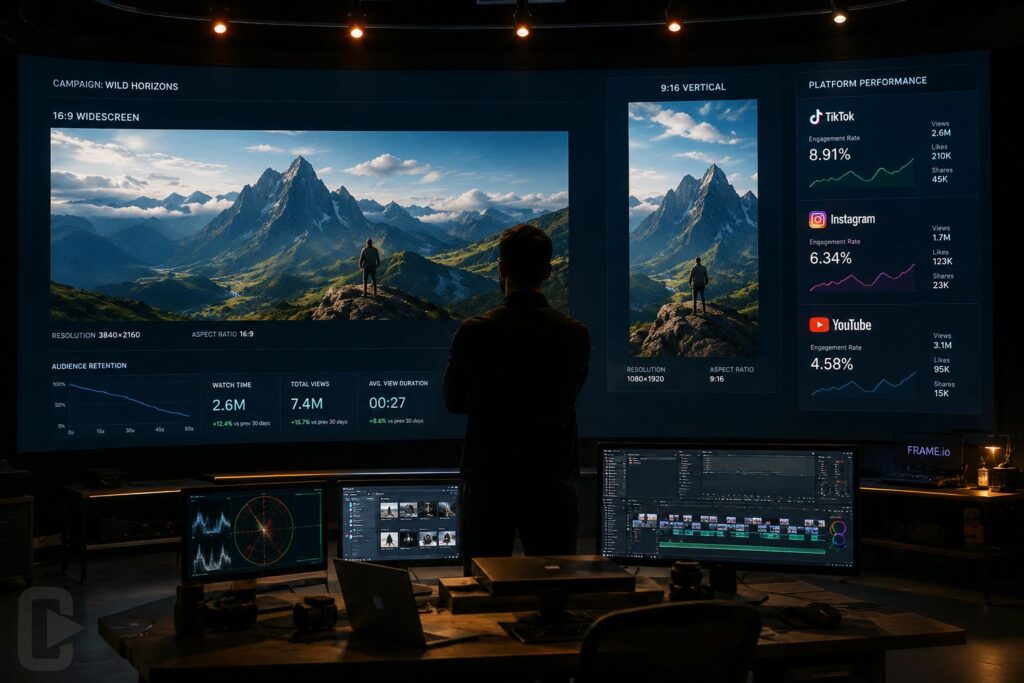
Mobile video consumption now accounts for more than 75 percent of all internet traffic, and TikTok, Instagram Reels, and YouTube Shorts collectively serve billions of vertical-format impressions every day. Yet the majority of the world’s premium video content — from Hollywood films to branded campaigns — was shot in 16:9 widescreen. This creates a genuine strategic crisis: studios and creators are sitting on libraries and campaigns that are invisible on the platforms that now drive the most content discovery.
This guide establishes a complete, actionable framework for building a vertical video strategy. Open with the problem, establish authority on the subject, and give the reader a clear table of contents so they can navigate to the section most relevant to their role — production, distribution, or monetization.
Why Vertical Video Is No Longer Optional
This section provides the statistical and behavioral case for vertical-first content. Cover four sub-points in depth. First, the algorithm advantage: TikTok, Instagram, and YouTube all explicitly favor native vertical formats in their recommendation engines, meaning re-uploaded horizontal content is deprioritized even when manually cropped. Second, the attention economy reality: research shows that users hold their phones vertically 94 percent of the time, and horizontal content causes an immediate friction that increases scroll-away rates by up to 60 percent within the first two seconds of viewing. Third, the revenue implication: CPM rates for native vertical video ads run 20 to 35 percent higher than equivalent horizontal placements because completion rates are substantially better. Fourth, platform projections: sustained investment from LinkedIn and YouTube in short-form vertical formats signals this shift is permanent, not cyclical. Close with a transition that reframes the question from whether to make vertical video to how to do it without sacrificing production quality.
The Rise of the 9:16 Economy
This sub-section focuses on the 9:16 aspect ratio and why it has emerged as the universal standard for mobile-first content. Explain the technical underpinning: the screen dimensions of all major smartphones make portrait mode the natural full-screen format. Cover platform requirements specifically: TikTok mandates 9:16 for full-screen placement, and YouTube Shorts requires it for monetization eligibility. Describe the broader cultural shift in which portrait mode is now the default lens through which an entire generation consumes video content. Use this section to introduce the idea that simply cropping or letterboxing widescreen content into 9:16 is not a viable strategy — it is a shortcut that produces a degraded experience — and set up the case for intelligent conversion.
What Happens When You Just Crop Horizontal Content
Address the instinct many creators and studios have to simply crop the center of a 16:9 frame to create a 9:16 output. Explain in specific terms why this destroys production value: essential action that was framed at the edges of the widescreen image disappears from the portrait frame, two-person dialogue scenes lose one of the speakers, wide establishing shots that provided spatial context become disorienting close-ups, and text overlays placed in the lower thirds of the original frame become unreadable or invisible. The core message of this section is that cropping is not conversion — it is a compromise that undermines the investment in the original production. Close by building urgency for a better approach.
The 4 Pillars of a Winning Vertical Video Strategy
This is the strategic framework that defines the pillar page. Lay out four distinct pillars that together form a complete vertical video strategy. Each pillar should feel actionable, distinct, and applicable to any organization regardless of size or content type. This framework is the section readers will bookmark, share, and return to.
Pillar 1: Intelligent Format Conversion at Scale
A serious conversion strategy requires understanding what is happening in each frame: where subjects are located, how the action moves, and what the emotional focal point is. The canvas must be adapted around those elements rather than forcing the content into a smaller box. Introduce the concept of generative AI expansion, where instead of cropping, the image canvas is intelligently extended using AI to fill the newly revealed portrait areas with contextually appropriate, seamlessly generated content. This approach preserves 100 percent of the original frame rather than discarding the portions that fall outside a center crop rectangle. It is a categorically different approach to the problem, and it is the first pillar of any strategy that treats production quality as non-negotiable.
Pillar 2: Distribution and Platform Strategy
Converting video to 9:16 is only half the equation. The second pillar is knowing where and how to distribute it. Cover the different platform requirements — file size limits, duration limits, caption formats, and upload specifications — for the major vertical video platforms. Address the difference between organic social distribution and paid placements, and what each requires in terms of format and pacing. Critically, introduce the concept of owned distribution channels — branded apps and OTT platforms — as the strategic counterweight to social media dependency. Creators and studios that distribute only through third-party social platforms are building audiences on rented land, with no control over monetization terms, algorithm changes, or audience data access. Owned distribution is the second pillar because it protects everything the first pillar creates.
Pillar 3: Content Cadence and Repurposing Workflows
A sustainable vertical video strategy requires a repeatable workflow, not a one-time conversion event. This pillar covers building a content calendar that accounts for vertical formats from the start of production planning, setting up a repurposing workflow that converts existing library content in systematic batches, and defining the right KPIs for vertical video performance. Relevant metrics include completion rate, save rate, and share rate — not raw view count, which can be inflated by autoplay without any genuine engagement. This pillar ensures that the strategy generates ongoing operational capability rather than collapsing after the initial push of organizational energy.
Pillar 4: Monetization — From Views to Revenue
The final pillar connects content strategy to business outcomes. Cover FAST channel monetization, in-app subscription revenue, brand sponsorship of vertical content, and how AI-converted catalog content unlocks entirely new revenue streams that the original horizontal version could not access. Vertical video opens platform brand partnership programs that are closed to horizontal content. It qualifies existing content for short-form monetization programs. And it enables the production of social media teasers that drive traffic back to owned subscription platforms. This section is the most commercially oriented of the four pillars and should close with a clear invitation to take the next step.
AI-Powered Vertical Video Conversion: How It Works
With the strategic case established, this section explains the technology that makes intelligent conversion possible. Three layers of AI work together in a high-quality conversion pipeline.
Subject tracking AI: computer vision that identifies the primary subject or subjects in each frame and ensures they remain centered and prominently framed throughout the conversion, regardless of how the action moves across the original widescreen canvas.
Scene understanding AI: models that interpret the emotional and narrative context of each shot and apply different reframing logic to an action sequence versus a dialogue scene versus a landscape establishing shot. One algorithm cannot serve all scene types equally; scene-adaptive logic is what separates professional conversion from consumer auto-reframe.
Generative fill AI: diffusion models that generate realistic, contextually appropriate content for the areas of the new portrait canvas that were outside the original widescreen frame. The AI does not guess; it analyzes the content and texture of the adjacent areas and generates content that is visually indistinguishable from what a camera would have captured if it had been framed in portrait mode. Include a mention of cliffhanger tagging: the AI system that identifies the highest-impact dramatic moments in a piece of content and automatically generates short-form vertical clips from those moments for social media distribution.
Building a Vertical Video Workflow for Your Organization
This section translates strategy into process. The workflow applies to any organization, from a solo creator to a legacy studio, and covers six stages.
Content audit: catalog existing horizontal assets by type, age, audience relevance, and licensing status. Not all content is equally worth converting; prioritization based on return-on-investment potential prevents the workflow from becoming overwhelmed before it produces results.
Prioritization: rank content for conversion based on which titles are most likely to generate immediate audience interest on vertical platforms, which carry the highest production value worth preserving, and which are in the most active licensing or distribution windows.
Conversion: execute AI-powered format conversion at scale. For large libraries, this stage is a series of sprint cycles rather than a single batch process. Define quality benchmarks before the first conversion sprint begins.
Quality review: a lightweight approval process to ensure AI output meets brand standards. For most content, this review is significantly faster than manual reframing because the AI handles all the compositional work; the reviewer is assessing output rather than creating it.
Distribution: push converted content to owned platforms and social channels simultaneously according to the platform strategy defined in Pillar 2.
Analytics: measure performance from the first day of distribution and iterate based on completion rate, engagement rate, and subscriber growth data. The workflow is a cycle, not a project.
Vertical Video for Different Industries
Vertical video strategy applies differently depending on the nature of the content and the business model behind it. Four industry profiles illustrate the range of applications.
Legacy studios and film libraries: converting decades of widescreen content for mobile audiences who discover new titles on short-form platforms rather than through traditional broadcast schedules or physical media. The challenge is scale; the opportunity is an entirely new audience for existing content with no additional production cost.
Brands and advertisers: adapting television commercials and horizontal digital campaigns for TikTok and Reels without re-shooting creative that represents significant production investment. The stakes are high because the brand’s visual identity must be preserved through the conversion. A crop-based approach fails here; generative expansion succeeds.
Independent creators and influencers: turning long-form YouTube content and podcast video recordings into short-form vertical clips that feed new platform audiences and drive them back to owned channels and subscription apps.
Enterprise and institutions: converting training videos, corporate communications, and HR content for mobile workforce consumption. Improved completion rates and knowledge retention are measurable business outcomes, not soft benefits.
Common Vertical Video Mistakes to Avoid
This section addresses the errors most frequently encountered when organizations move quickly into vertical video production or conversion without a framework.
Cutting subjects at the neck in portrait frame: a common output of automated center-crop tools that do not account for the height of the primary subject relative to the aspect ratio change.
Applying horizontal pacing to vertical content: vertical video audiences expect and reward faster cuts and tighter editing. The patience built into a horizontal viewing session on a sofa does not transfer to a mobile scroll session.
Ignoring safe zones for platform user interface overlays: captions, interactive stickers, profile handles, and platform controls occupy predictable regions of the vertical frame. Content placed in those zones will be obscured.
Neglecting captions: research consistently shows that the majority of social video is watched without audio. Captions are not an accessibility feature in this context; they are a primary communication channel.
Treating vertical content as a secondary deliverable: organizations that produce horizontal content first and create vertical as an afterthought produce vertical content that feels like an afterthought. The strategy must treat vertical as a primary format, not a repurposing step.
Format each question with a direct, complete answer in the first sentence before providing supporting context. Answers should run 50 to 75 words each.
Conclusion
Vertical video is not a format preference — it is a distribution necessity. The organizations that build efficient conversion workflows now will own the mobile audience of the next decade. Summarize the four strategic pillars, reinforce the central thesis, and leave the reader with a sense of momentum and a clear path forward, whether they are adapting a single campaign or converting a 10,000-hour library.