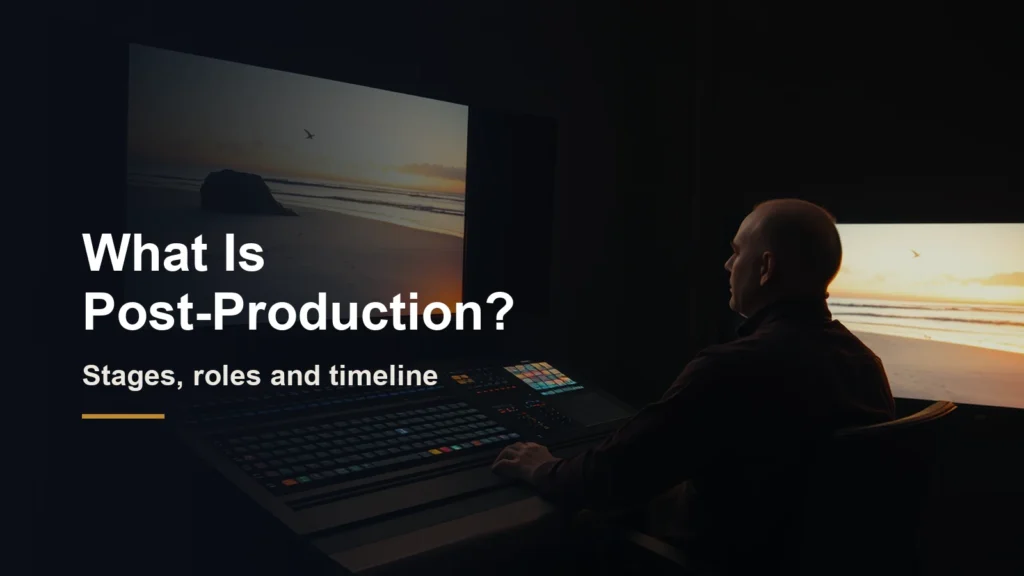
Post production is everything that happens to a film, series or video after the cameras stop rolling: editing the story, adding visual effects, grading color, building and mixing sound, adding titles and captions, checking quality, and packaging the finished master for delivery. It is where footage becomes a finished program.
It is also where most of the schedule and a surprising share of the budget goes. This guide explains what post-production includes, the stages in order, who does the work, how long it typically takes, and where AI is starting to help the people doing it.
Key takeaways
- Post-production covers all the work done after principal photography: editing, VFX, color, sound, music, titles, quality control and deliverables.
- It does not wait politely for the shoot to end. Editors often cut scenes while the production is still filming.
- Picture lock is the pivot point: once the edit is locked, VFX, color, sound and music can finish against a fixed timeline.
- Timelines range from months to more than a year depending on effects, and guild agreements set minimum time for key steps such as the director’s cut.
- AI is useful in post when it removes repetitive work (search, cleanup, reformatting, version checks) and leaves creative decisions with editors, colorists and mixers.
Table of contents
- What is post-production?
- Post-production, post production or postproduction?
- Pre-production vs production vs post-production
- The stages of post production, in order
- Examples of post-production work
- Who works in post-production?
- How long does post-production take?
- How AI is changing post-production
- Planning your own post: where to start
- Frequently asked questions
What is post-production?
Post-production is the final phase of making a film, TV show, commercial or any produced video, in which recorded footage and audio are shaped into a finished, deliverable program. Wikipedia’s summary is a good plain definition: post-production “includes all stages of production occurring after principal photography” or after recording individual program segments.
In practice, that means three kinds of work happening in parallel:
- Story work. Choosing takes, structuring scenes, finding the rhythm and cutting what does not serve the story.
- Craft work. Visual effects, color grading, dialogue editing, sound design, Foley, music and the final mix.
- Technical work. Managing media and metadata, conforming the edit back to original camera files, quality control and building the masters and versions that distributors require.
The same Wikipedia article makes a point that surprises people new to the industry: “post-production may occur at any point during the recording and production process.” On most professional shoots, an editor and assistants are already assembling scenes from dailies while the crew is still filming. That early cut tells the director whether a scene needs a pickup shot before the set is struck, which is far cheaper than discovering the gap months later.
Post-production, post production or postproduction?
All three spellings are in use, and none is wrong. The hyphenated “post-production” is widely used in industry writing and job titles (the DGA’s contract summaries use it, for example), the closed “postproduction” is common in American usage, and “post production” with a space is what many people type into search. Crews usually shorten it to “post,” as in “we’re in post until March.”
What matters is consistency within a document, a contract or a job posting. Pick one form and use it everywhere, including in file names and folder structures, so that searches across your shared storage actually find things.
Pre-production vs production vs post-production
The difference is timing and purpose: pre-production plans the project, production captures the material, and post-production turns that material into the finished work. Each phase answers a different question.
| Phase | Core question | Typical outputs | Who leads |
|---|---|---|---|
| Pre-production | What are we making, and how? | Script, budget, schedule, storyboards, previs, casting, locations, workflow plan | Producer, director, line producer |
| Production | Did we capture what the story needs? | Camera original files, production sound, script notes, dailies | Director, cinematographer, 1st AD |
| Post-production | Does the finished program work, and does it meet spec? | Locked cut, VFX, graded picture, final mix, captions, QC-passed masters and versions | Editor, post supervisor, director, producers |
The boundaries blur. Good post teams are involved in pre-production, because decisions made there (camera format, frame rate, color pipeline, how many VFX shots) set the cost and difficulty of everything that follows. A workflow test before day one of the shoot is one of the cheapest insurance policies in filmmaking.
The stages of post production, in order
Most film and TV projects move through eight broad stages of post production. Their order overlaps in practice, but the sequence below reflects how material flows from the camera card to the delivered master.
1. Ingest and dailies
Camera and sound files are copied, verified and backed up, then synced and turned into lightweight editing files. Dailies let the director and producers see each day’s work, and they give the editor something to cut with.
2. Editing
The editor builds an assembly, then works with the director toward the director’s cut, followed by rounds of producer, studio or client feedback. Editing ends at picture lock, when the timeline is frozen for the finishing departments.
3. Visual effects
VFX ranges from removing a visible microphone or a modern sign in a period film to fully computer-generated environments and creatures. Temporary effects go into the cut early so reviewers can judge scenes, and final shots replace them as they are approved.
4. Color grading
A colorist balances shots so they match, then shapes the look of the whole program. Grading also produces separate versions for different displays, such as a high dynamic range and a standard dynamic range master.
5. Sound editorial and design
Dialogue is cleaned and assembled, lines recorded poorly on set are replaced through ADR, Foley artists perform footsteps and props, and sound designers build the world around the picture.
6. Music
A composer scores to picture, a music editor fits and edits cues, and licensed songs are cleared. Music usually cannot finish until the edit is locked, because every trim changes the timing.
7. Mix, titles and finishing
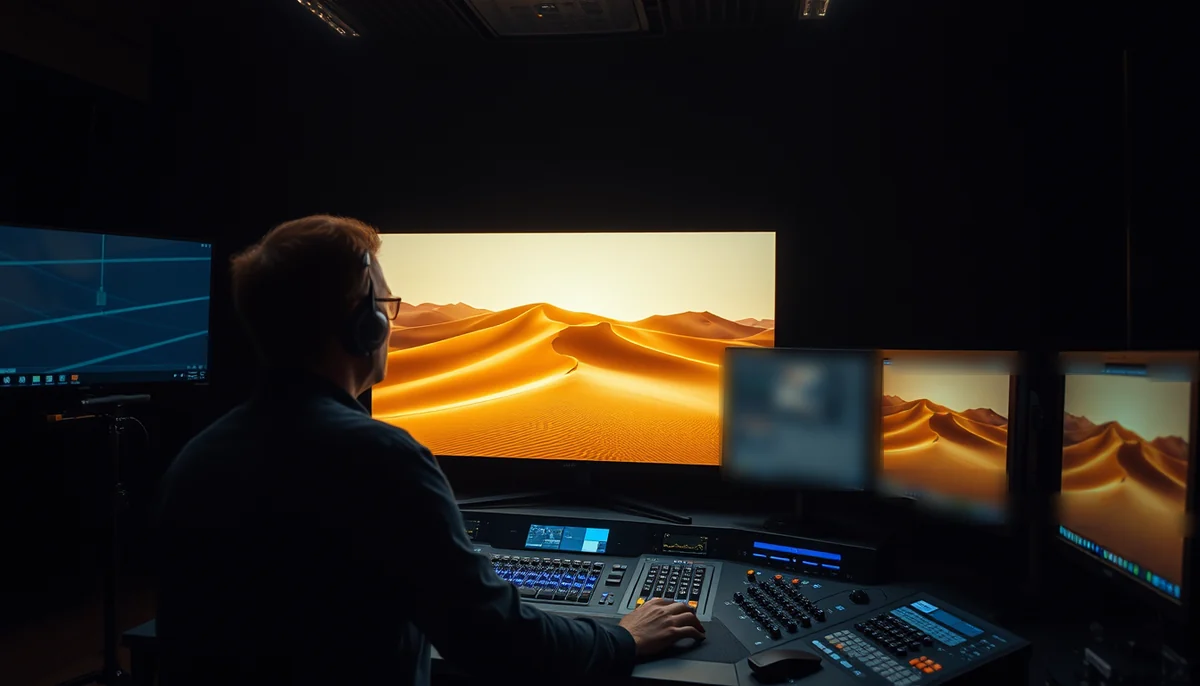
The re-recording mixers combine dialogue, effects and music into the final mix and its alternate versions. In parallel, titles and credits are added, and an online editor conforms the edit to the full-resolution camera files and assembles the finished picture.
8. Quality control and deliverables
The finished program is checked for technical faults, such as dropped frames, audio sync drift and levels out of spec, and then packaged in the formats each buyer requires. Many distributors now take file-based masters. The SMPTE Interoperable Master Format, for example, is described by SMPTE as a framework for handling “multiple content versions (airline edits, special edition, languages…) of the same high-quality finished work,” which is exactly the versioning problem deliverables teams face.
Examples of post-production work
Post-production work is any task that changes, repairs, adds to or packages recorded material after capture. Some concrete examples from real projects:
- Cutting a 40-minute interview down to a tight three-minute segment for a documentary.
- Removing a boom microphone that dipped into frame during the best take.
- Replacing a line of dialogue ruined by a passing truck with a clean ADR recording.
- Matching the color of footage shot on two different camera models so the scene reads as one moment.
- Adding a snowfall, a crowd or a set extension that would have been too expensive to shoot.
- Recording footsteps, cloth rustle and door handles on a Foley stage.
- Mixing a 5.1 surround version and a stereo version from the same sessions.
- Creating subtitles, closed captions and dubbed language tracks for international release.
- Producing a 9:16 vertical version of a trailer or episode for mobile platforms.
- Running a QC pass and fixing flagged issues before the file goes to a streamer or broadcaster.
Notice how many of these are versions rather than new creative work. The last two examples in particular have grown fast as programs now need to live on more screens and in more shapes than a single broadcast master.
Who works in post-production?
Post-production is a team of specialists coordinated by a post supervisor or post producer. On a small corporate video, one editor may cover several of these jobs. On a feature or high-end series, each row below can be a department.
| Role | What they do |
|---|---|
| Editor | Shapes the story from the footage, working closely with the director |
| Assistant editor | Organizes media, prepares bins and sequences, handles turnovers to other departments |
| Post supervisor / post producer | Owns the post schedule, budget, vendors and delivery |
| VFX supervisor and artists | Plan, create and review effects shots |
| Colorist | Matches shots and creates the final look and display versions |
| Supervising sound editor, sound designers, Foley artists | Build the dialogue, effects and ambience tracks |
| Composer and music editor | Write, fit and edit the score and licensed music |
| Re-recording mixer | Balances all audio into the final mix and alternate mixes |
| Online editor / finishing artist | Conforms the edit to full-resolution media and assembles the master |
| QC operator and deliverables team | Check the program against spec and produce every required version |
The director and producers sit above all of this as the people who review and approve the work. A large part of post, in other words, is a structured conversation between makers and approvers, and it runs through many versions of the same material.
How long does post-production take?
It depends on length, effects and the number of deliverables, but post usually takes longer than the shoot. Wikipedia’s article on the topic states that post-production “requires anywhere from six months for a small film to over a year for a film laden with visual effects.”
Some minimums are contractual. Under the Directors Guild of America’s Basic Agreement, the producer must give a director time to complete the director’s cut of a theatrical feature of “ten weeks, or one day of editing for each two days of scheduled photography, whichever is longer.” For long-form television films of 91 minutes to two hours, the same DGA summary lists 20 days. Those are only the director’s editing periods. Producer and studio cuts, effects, grading, music, the mix and QC all come after or alongside them.
The main drivers of a post timeline are:
- Number and complexity of VFX shots. These usually set the critical path on effects-heavy work.
- Review rounds. Every round of notes from directors, producers, studios, clients or legal adds days, sometimes weeks.
- Music. An original score written to a locked picture takes time that cannot easily be compressed.
- Deliverables. Each extra language, aspect ratio, dynamic range version or platform cut adds work and another QC pass.
Key insight: Shooting days are fixed by budget, but post schedules slip through review. The fastest way to shorten post is rarely to work faster at the craft; it is to make every review round shorter, clearer and final.
How AI is changing post-production
AI is entering post-production mainly as an assistant to specialists, handling the repetitive and measurable parts of the job so artists spend more time on judgement calls. The useful applications today tend to fall into a few groups:
- Finding material. Transcription and visual search let an editor locate every take of a line in seconds rather than scrubbing through hours of footage.
- Cleanup and repetitive VFX. Rotoscoping, object removal and noise reduction are tedious by hand and well suited to machine assistance, with an artist reviewing every shot.
- Versioning. Reformatting a finished program for new aspect ratios, resolutions or platforms, which is increasingly part of deliverables.
- Review and QC. Comparing versions frame by frame to confirm that only the intended changes were made.
At CineVision we build for those points in the pipeline. Big Idea, our AI-assisted production platform, lets teams upload footage they shot and use text prompts to add, edit or enhance VFX elements, and it keeps characters and environments consistent across shots. Reframe converts a finished master between aspect ratios, including legacy 4:3 material to vertical 9:16 or 16:9, up to 4K, without pan-and-scan cropping. PeakView handles the comparison side of review, which is covered below.
Key insight: The question to ask of any AI post tool is not “what can it generate?” but “which decision does it leave with a human, and how easily can that human check the result?”
That principle is the core of what we call Human Generative Workflows: people direct and approve, machines do the heavy lifting in between. It is also why AI has not shortened the need for editors, colorists or mixers. It has shifted some of their hours from repetitive tasks to creative ones.
Planning your own post: where to start
If you are budgeting or scheduling post production for a film, series or branded project, three decisions made early will save the most money later.
- Start from the deliverables list. Know every master, language, aspect ratio and platform version you owe before you shoot. It shapes camera format, framing and the finishing budget.
- Test the workflow before day one. Run a short test from camera card through dailies, editorial and a sample conform so that problems appear while they are cheap.
- Design the review process. Decide who reviews each stage, who has final approval, where notes live and how new versions are compared with old ones.
The third point is where most schedules quietly slip. PeakView, CineVision’s QA workspace, puts two versions side by side and synced to the frame, lets reviewers leave notes at the exact timecode, and exports those notes with timecodes or as JSON for the editorial pipeline. If you are planning a production that also needs AI-assisted previs or VFX, our guide to making a complete film with AI walks through how those tools fit alongside a traditional post team.