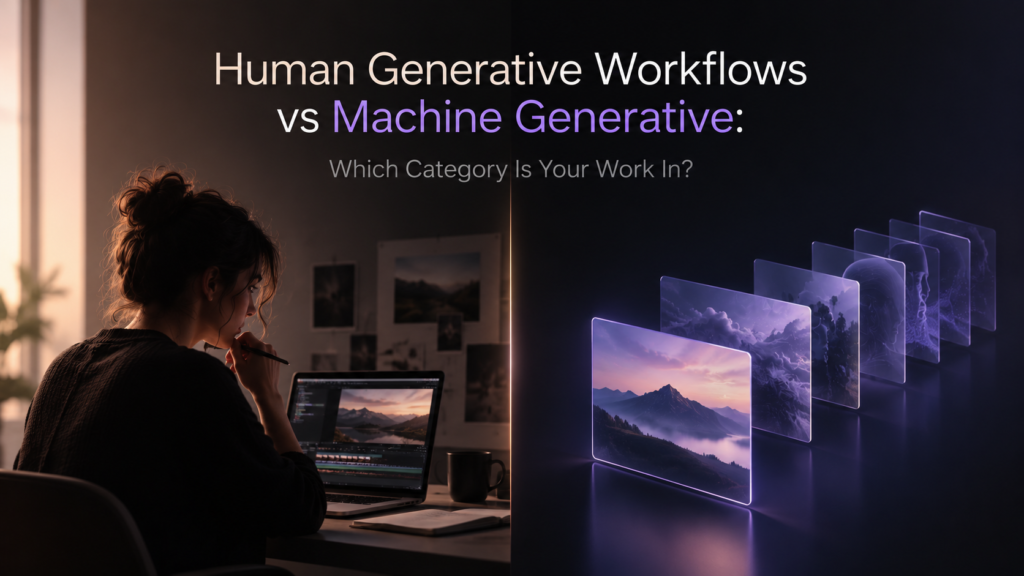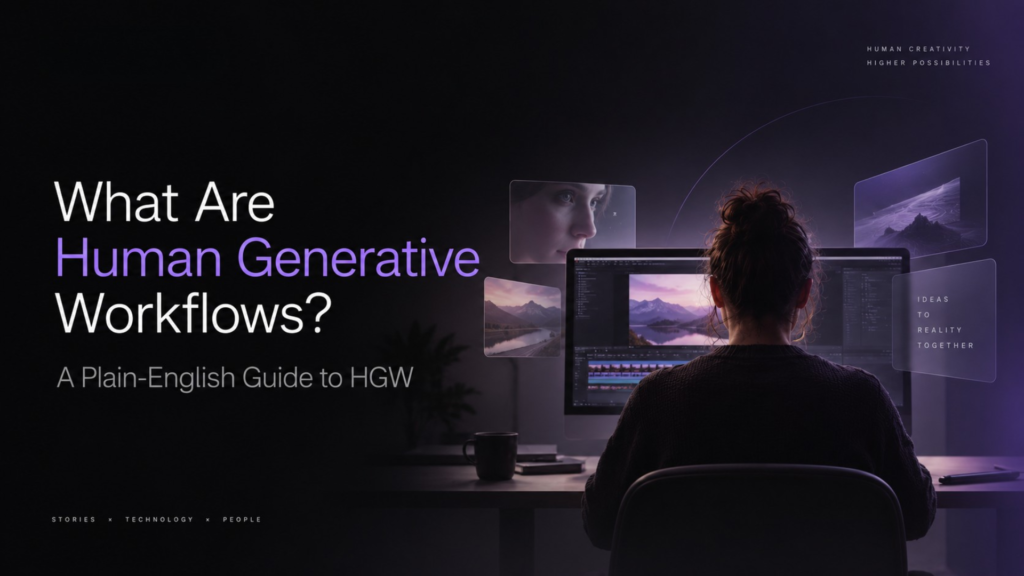
Human Generative Workflows is a term that did not exist in common use two years ago and is now being adopted across film and television at speed. It came out of a specific problem: the industry had one acronym doing far too much work, and no vocabulary for the thing most professionals were actually doing.
This is a plain-English guide to what Human Generative Workflows means, where the term came from, and why it has landed so quickly.
Table of contents
- What Human Generative Workflows means
- Where the term came from
- The problem HGW was created to solve
- The three categories
- What an HGW pipeline actually looks like
- A worked example
- What HGW is not
- Why copyright makes this concrete
- Frequently asked questions
Key takeaways
- Human Generative Workflows are artist-controlled pipelines where generative models operate inside professional tools under a human artist’s direction.
- The defining characteristic is granular human control — the artist defines parameters, provides inputs, and evaluates output at every step.
- HGW sits between embedded AI utilities and purely machine-generated content, and is human-authored and copyrightable.
- The term emerged from private industry conversations begun in November 2023 by producer Kathleen Kennedy and AFI Conservatory Dean Susan Ruskin.
- HGW reframes the industry question from “did you use AI?” to “where, and how, did you use it?”
What Human Generative Workflows means
Human Generative Workflows — HGW — are pipelines where, much like CGI, a human artist and their team make the decisions.
Generative models integrated into these workflows serve the artist’s creative vision by preserving, and often enhancing, precision and control. The artist defines the parameters, provides the inputs, and evaluates what comes back at every step of a process that usually involves multiple traditional and modern tools working together.
The work happens inside professional software — Nuke, Unreal, After Effects, Blender, ComfyUI, DaVinci Resolve — with specialised generative models brought into that pipeline under the artist’s control, frequently alongside tightly trained LoRA models, ControlNets and structured inputs.
The outputs are human-crafted, and they are copyrightable.
Human Generative Workflows take different shapes in different crafts. Visual production is the clearest illustration, but the same logic applies in sound, music, editing and the writing room: artist-led, granular control, iteration. It will extend to ways of working that have not been named yet.
Where the term came from
HGW grew out of a series of private, off-the-record conversations begun in November 2023 by producer Kathleen Kennedy and AFI Conservatory Dean Susan Ruskin.
In the aftermath of the Hollywood strikes, they brought together filmmakers, actors, studio executives, guild leaders, technologists and Silicon Valley figures to explore how generative technology could enter filmmaking without displacing human creative authorship.
Over nearly three years of meetings, demonstrations and working sessions, the group converged on a specific diagnosis: the term “AI” was being used to describe radically different creative processes, and that ambiguity was causing real damage. Those discussions produced the HGW framework, which distinguishes artist-controlled generative workflows from primarily machine-generated work and proposes a common vocabulary centred on human creative control.
The framework is deliberately narrow. It addresses shared language around forms of AI use in production workflow. It does not attempt to resolve training data, licensing, labour transition, consent or economic policy — all of which need their own legal, commercial and social solutions. A common vocabulary is simply the foundation those conversations require.
The problem HGW was created to solve
One acronym was doing too much work.
“AI” was being asked to describe both a noise-reduction feature that has lived inside post-production software for years and the capabilities of generative models that did not exist two years ago. It was used in the same breath for a colour-grading assist in DaVinci Resolve and a prompted synthetic performance replacing an actor. It applied equally to the CGI pipeline artists spent a decade mastering and to a deepfake made without consent.
That ambiguity surfaced in every contract negotiation, credit conversation, guild discussion and audience disclosure question. It created friction precisely where the industry needed shared ground.
The binary — AI was either used or it was not — does not hold up against a real pipeline. What was needed was a map.
The three categories
Three distinct forms of AI usage are emerging, each usable for exploration and for producing final footage. The final-footage case is where consequences attach.
Utility techniques and embedded AI — copyrightable. Denoising, upscaling and sharpening, audio separation, rotoscoping, depth extraction, markerless motion capture, wire removal and inpainting. These generally answer questions with a defined correct answer, not subject to much creative interpretation. Most productions already use them without flagging it.
Human Generative Workflows — copyrightable. Artist-controlled pipelines integrating specialised generative models inside VFX or production tools. Human-authored, and the product of deliberate creative decisions.
Machine Generative (MG) — not copyrightable, or likely not. Purely machine-generated likenesses, voices, performances or stories that substitute for human creative work. A prompt-based tool is not precise enough; it replaces human creative vision with a generative model.
Over time these categories could form a shared classification system — used internally on productions, in credits, and in guild-facing documentation.
What an HGW pipeline actually looks like
An HGW production might begin with an artist or team hand-painting reference art that establishes the look.
That reference work becomes training data for a small custom model, fine-tuned on the team’s own artwork and original IP rather than the open internet. The artists generate outputs using the trained model, then paint over what is not right and retrain.
The custom-trained model can then generate elements that integrate with the rest of the production pipeline in various ways. Scenes — or keyframes used in the animation process — are assembled with intentional camera, lighting and composition. Traditional compositing brings everything into the final frame. Colour and finishing happen as on any other production.
At every stage a human is making an expressive decision. That is the whole point.
A worked example
Dear Upstairs Neighbors, a six-minute animated short directed by Connie He and produced by Márcia Mayer, premiered at Tribeca Festival in June 2026.
It was made by a team of roughly forty-five people — animation veterans from Pixar and DreamWorks working alongside researchers and engineers from Google DeepMind. Every frame on screen is generated by a series of fine-tuned machine-learning models alongside traditional editing tools. Every frame is also entirely human-authored.
The team hand-painted concept art establishing the film’s visual language. They fine-tuned small custom models on their own original artwork. They developed video-to-video workflows in which animators supplied rough animation as the structural backbone for generated output. When results did not match intent, they painted over, retrained and iterated.
The pipeline was artist-led. Control was granular, built on custom training on the team’s own work. Iteration allowed multiple cycles of creative exploration and discernment. Generative components contributed to a larger production process where human judgement governed every decision.
The team’s artistic decisions are visible in every frame, even though no frame was hand-drawn. HGW proposes that creative authorship is human even when rendering is generative — an incremental step along the continual evolution of computer-generated imagery rather than a departure from it.
What HGW is not
Human Generative Workflows are not a tool for replacing writers and actors, automating performances, or generating story without a human author.
The distinction between HGW and prompted generation is not a technicality. It is the difference between a set of tools and processes serving human creative vision, and a tool that replaces it.
That is worth stating plainly, because the term is new enough that it could be misused as cover. A pipeline is not an HGW because someone says so. It is an HGW because a human artist genuinely determined the expressive result at each step, and can show it.
Why copyright makes this concrete
The U.S. Copyright Office has published guidance that maps closely onto the HGW distinction.
Copyright does not extend to purely AI-generated material, or to material with insufficient human control over expressive elements. Prompts alone do not provide that control. But human-authored expression remaining perceptible in an AI-assisted output may be protected, as may original human modifications or the human selection, coordination and arrangement of material.
That is the legal shape of the same line HGW draws creatively. It is also why the framework has been adopted so quickly — it gives productions language for something that already had commercial consequences and no vocabulary.
For related reading, see our guides to AI and copyright in film, production ComfyUI workflows and HGW versus machine generative work.
The bottom line
Human Generative Workflows give a name to what most serious practitioners were already doing: using generative tools inside an artist-led process rather than instead of one.
The more useful question was never “did you use AI?” It was always “where, and how, did you use it?” HGW is the vocabulary that makes that question answerable.
Frequently asked questions
What does HGW stand for?
Human Generative Workflows — artist-controlled pipelines where generative models operate inside professional production tools under human creative direction.
How is HGW different from just using AI?
“Using AI” covers everything from denoise filters to fully machine-generated performances. HGW describes one specific case: generative models integrated into an artist-led pipeline where a human determines the expressive result at each step.
Is work made with Human Generative Workflows copyrightable?
Yes. Because expressive decisions are made by humans throughout, HGW output is human-authored. This contrasts with purely machine-generated material, which is not copyrightable or very likely not.
Who created the HGW framework?
It emerged from private industry conversations begun in November 2023 by producer Kathleen Kennedy and AFI Conservatory Dean Susan Ruskin, involving filmmakers, actors, studio executives, guild leaders and technologists over nearly three years.
Does HGW apply outside visual effects?
Yes. The framework was described using visual production examples, but the same logic — artist-led, granular control, iteration — applies to sound, music, editing and writing, and to crafts not yet named.
Does HGW mean fewer jobs?
Not in the artist-led form. The clearest documented example involved roughly forty-five people across traditional animation crafts and engineering. HGW describes a pipeline where human decisions govern throughout, which is labour-intensive by definition.