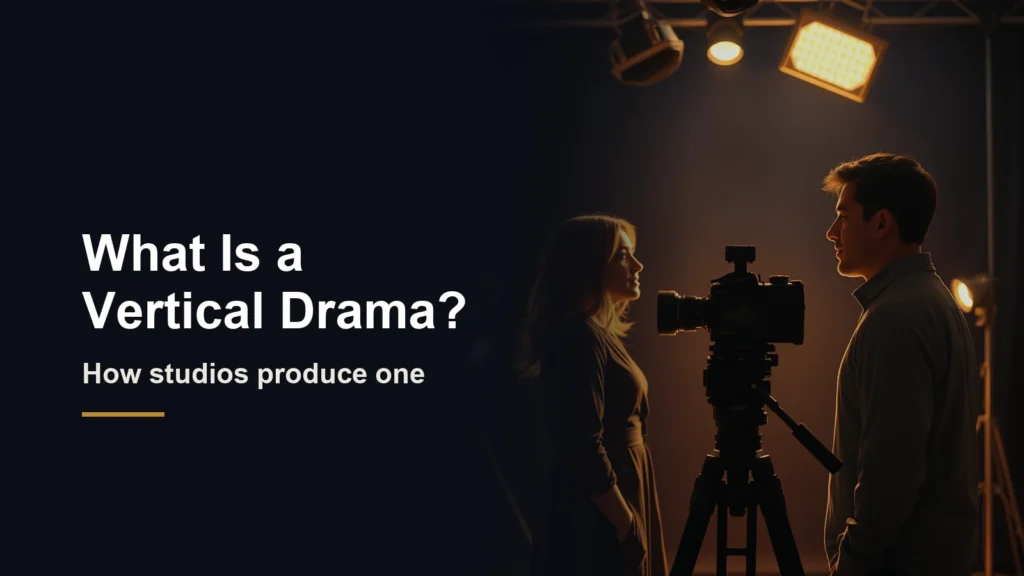
A vertical drama is a scripted series shot natively in the 9:16 phone format and released as very short episodes, typically one to two minutes each, across seasons that can run to dozens of installments. Each episode ends on a hook, and viewers usually reach later episodes by paying per episode, subscribing or watching ads.
It is a genuine format, not television cut short, and studios that treat it as short TV tend to get it wrong. This guide explains what defines a vertical drama, why the business is attracting studios and unions, and how production actually works, from the writers’ room through shooting, casting, budget and post.
Key takeaways
- A vertical drama is a serialized, scripted story made for phones: 9:16 frame, episodes of roughly one to two minutes, a cliffhanger in every episode.
- The format began in China and has grown into a large US business led by apps such as ReelShort and DramaBox.
- Vertical composition has its own grammar: faces dominate, environments are implied and on-screen text carries meaning.
- Budgets shift toward cast and schedule discipline and away from locations; volume makes season totals substantial.
- SAG-AFTRA launched a dedicated Verticals Agreement in October 2025 for productions under $300,000.
- Studios can enter by converting existing titles for data, then originating vertical-native series.
Table of contents
- What is a vertical drama?
- Anatomy of the format: episodes, seasons and the paywall
- Why studios are paying attention
- Writing a vertical drama
- Shooting for 9:16: the grammar of the vertical frame
- Casting, performance and union coverage
- Vertical drama budget and schedule: where the money goes
- Convert or originate: where studios have the edge
- Deciding how to enter the format
- Frequently asked questions
What is a vertical drama?
A vertical drama is serialized scripted fiction produced for a phone held upright, structured as a long run of very short episodes designed to be watched back to back. The closest traditional relative is the soap opera, compressed and rebuilt for mobile viewing.
The format grew out of China, where it is known as duanju, or short drama. Wikipedia’s entry describes it as originating from serialized short videos on platforms such as Douyin and Kuaishou from around 2018, with episodes of 1–2 minutes and series of 20 to 100 episodes. You will also see the terms microdrama, short drama and vertical series used for the same thing. For the category overview, our explainer on microdramas covers the market; this guide focuses on how a vertical drama is made.
Three things separate a vertical drama from other short video:
- It is scripted and serialized. A story runs across the whole season, not a collection of standalone clips.
- It is composed for 9:16. Framing, blocking and camera movement are planned for the vertical frame from the script stage.
- It is structured around a paywall or ad gate. Early episodes are free; later ones cost money or ad views, which shapes where the biggest cliffhangers sit.
Anatomy of the format: episodes, seasons and the paywall
The unit of a vertical drama is the one-to-two-minute episode, but the unit of revenue is the season. The table compares it with the two formats people most often confuse it with.
| Feature | Vertical drama | Traditional TV drama | Short-form social video |
|---|---|---|---|
| Frame | 9:16, shot natively | 16:9 or wider | Mostly 9:16 |
| Episode length | About 1–2 minutes | 20–60 minutes | Seconds to a few minutes, usually standalone |
| Story | One serialized arc across dozens of episodes | Acts and subplots within and across episodes | Rarely serialized |
| Hook cadence | Reversal or cliffhanger every episode | Act breaks and episode endings | First seconds only |
| Revenue | Per-episode payments, subscriptions, ads or a hybrid | Subscriptions, license fees, ads | Platform ad share, brand deals |
Monetization follows three models. Wikipedia’s duanju entry describes in-app purchase, where viewers pay for episodes individually or in bundles (typically $0.30–$0.50 per episode), in-app advertising with free content, and hybrids that mix free episodes, paywalls, rewarded ads and subscriptions. The paywall position is a creative decision as much as a commercial one: the episode just before it needs the strongest hook in the season.
Why studios are paying attention
Studios are paying attention because the audience and the spending are already large, and the format is moving toward the mainstream industry. Three signals stand out.
Consumer spending. Sensor Tower’s State of Short Drama Apps 2025 report put global in-app revenue from short drama apps at approximately $700 million in Q1 2025, with the US accounting for 49% of that total. ReelShort and DramaBox led, at about $130 million and $120 million respectively for the quarter.
Union recognition. In October 2025, Deadline reported that SAG-AFTRA had launched a Verticals Agreement for serialized micro-dramas, covering productions with budgets under $300,000. The same report noted that the WGA had told members vertical work is covered by its basic agreement, and cited US micro-drama revenues of $819 million in 2024, projected to reach $3.8 billion by 2030.
Mainstream platforms testing vertical. TechCrunch reported in April 2026 that Netflix introduced Clips, a vertical video feed of highlights from its own programming. That is a discovery feature rather than a vertical drama slate, but it shows large streamers building for upright viewing.
Key insight: A union agreement is a maturity signal. Once guild terms exist, vertical drama stops being a gray-market experiment and becomes a format that professional producers can budget, insure and staff like any other.
Writing a vertical drama
Writing a vertical drama is a specialism. The story must deliver a payoff and a new question roughly every minute, for dozens of episodes in a row.
- Open inside the scene. There is no room for establishing. The first line should carry conflict, information or a question.
- Compress exposition. Backstory has to arrive inside dialogue that is doing other work at the same time.
- Write to the cliffhanger. Every episode ends by opening a question. It is structural, not stylistic; it produces the next tap.
- Keep scenes small. Two characters per scene is comfortable in a vertical frame; three-way conversations create problems the director inherits.
- Assume the sound is off at first. The opening seconds must read visually, with on-screen text where needed.
- Plan the season around the paywall. Know which episode sits just before the paywall and build the biggest reversal there.
Writers’ rooms built for eight one-hour episodes often struggle with the cadence. Outlining the whole season as a beat sheet, one line per episode, before drafting any pages keeps the hooks evenly spaced.
Shooting for 9:16: the grammar of the vertical frame
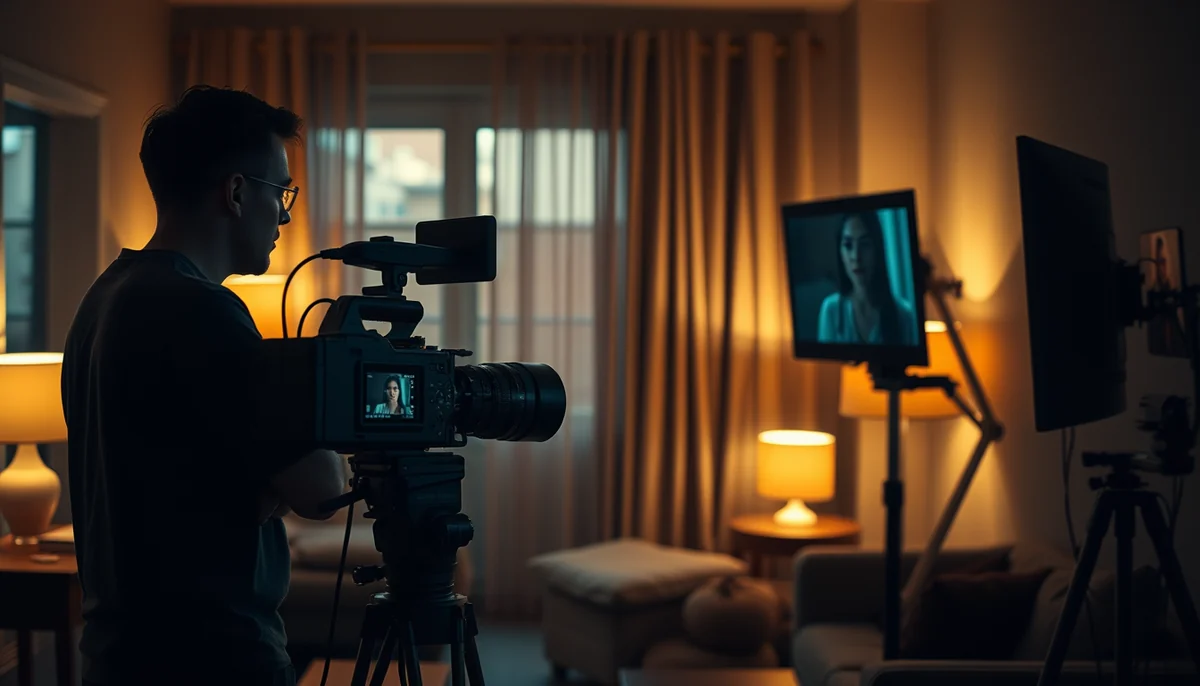
Composing for vertical is not a constraint applied to horizontal thinking. It has its own grammar, and directors used to traditional coverage need to adjust deliberately.
- Faces dominate. The vertical frame favors the human face at a scale horizontal rarely uses, so performance and casting carry more weight.
- Two-shots need staging. Side-by-side blocking does not fit. Depth staging, over-the-shoulder shots or deliberate alternation do.
- Environment is implied. There is no room for a sweeping establishing shot; location comes through detail.
- Movement is vertical. Tilts, push-ins and reveals from top to bottom do the work that pans do in widescreen.
- Text is part of the design. Captions and on-screen text sit inside the composition, so leave space for them and for the app’s interface.
Plan framing with the edit in mind. If the series may later be distributed in widescreen, consider protecting a horizontal-safe area or capturing extra frame on key scenes, which keeps later versioning options open.
Casting, performance and union coverage
Because the vertical frame holds the face so close, casting matters more than in almost any other format. Performances need to read at close range without theatricality: small expressions register strongly and large ones look excessive.
Volume changes the practical side too. Long shooting blocks with the same principal cast make availability and stamina real casting criteria. On the contract side, the SAG-AFTRA Verticals Agreement gives producers under the $300,000 budget threshold a union route designed for the format’s pace, and Deadline’s reporting notes that much existing vertical work had been non-union. Check current terms directly with the union before budgeting cast.
Vertical drama budget and schedule: where the money goes
A vertical drama budget has a different shape from traditional drama. Cost per finished minute can be lower, but season totals stay substantial because of episode volume.
- Cast and performance take a larger share. Faces carry the format.
- Locations take a smaller share. The vertical frame sees far less of any environment.
- Schedule is the cost driver. Dozens of episodes mean fast days, block scheduling by location and strict limits on setups per scene.
- Post is heavier per minute. Higher cut rates, more text and graphics, more sound work per screen minute.
- Marketing is platform-native. Trailers and clips built for feeds rather than a campaign.
Two production habits keep the economics viable. First, a house look agreed in pre-production removes decisions from the set floor. Second, editorial runs alongside the shoot rather than after it; with episode counts this high, sequential post is impractical. For line-item costing and format options, our microdrama production cost guide goes deeper.
Key insight: Vertical drama saves money through discipline, not through lower standards. Apply television-scale process and the format’s cost advantage disappears while its volume remains.
Convert or originate: where studios have the edge
Studios bring real advantages to vertical drama: better craft, proper rights handling, talent relationships and existing IP that can be extended rather than started cold. The counterweight is speed, because studio approval processes are built for a slower cadence.
A studio with a catalog has two ways in, and they answer different questions:
- Convert existing material. Cheaper and fast, it uses production value already paid for and generates audience data quickly. It suits dialogue-driven titles with tight coverage. ReFrame converts horizontal masters to 9:16 up to 4K without pan and scan, and its episode and cliffhanger engine suggests where to slice a long-form title into serialized episodes.
- Originate vertical-native series. Built for the format’s grammar, which converted material cannot fully match. It costs more and takes longer, but the story is designed for the screen from the first page.
AI can support origination without replacing the people who make it. Big Idea, CineVision’s AI-assisted production platform, takes a project from script to storyboard, pre-visualization and render, keeps characters and environments consistent across shots, and lets teams add or refine VFX on footage they shot, while writers, directors and performers keep creative control. Most studios are best served by doing both: convert to establish presence and learn, then originate once the data shows who is watching.
Deciding how to enter the format
Vertical drama rewards producers who respect it as a distinct format and punishes those who treat it as television cut short. Decide early whether you are testing with converted titles or committing to original series, write the season around its hooks and paywall, and build a schedule the volume can survive.
Distribution is the last decision and an important one. Tall Tale lets you launch your own branded vertical streaming app for iOS and Android, set subscription, advertising or pay-per-view per show, and publish ready-made episodes from ReFrame alongside your originals, so the audience you build belongs to you.