Introduction
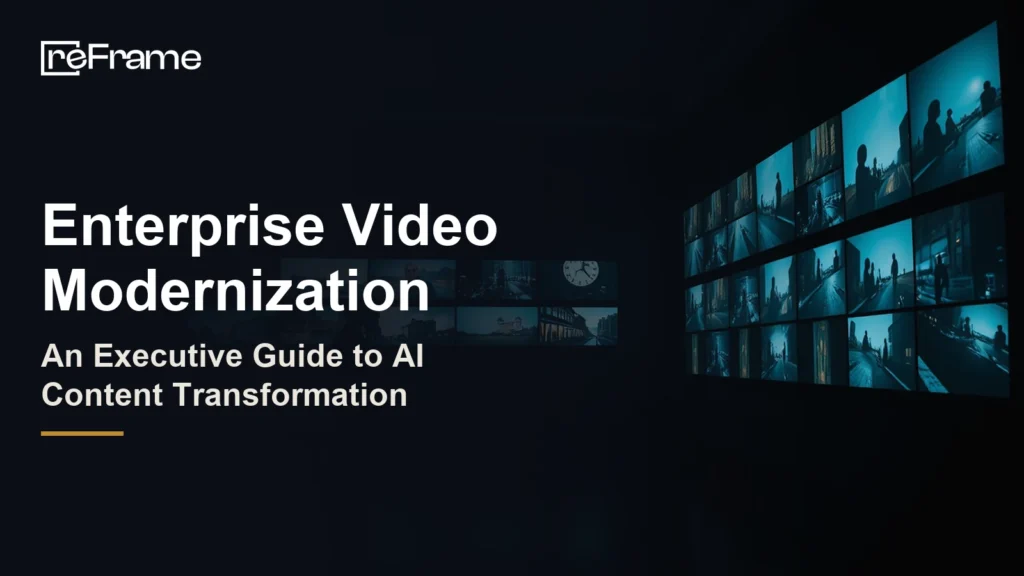
The average enterprise employee now spends four or more hours per day consuming content on a mobile device, yet the majority of corporate training and internal communications video content was produced in horizontal format and optimized for desktop viewing. The result is a measurable engagement gap: mobile consumption of horizontal corporate video is significantly shorter in average session duration than desktop consumption of the same content, which means the knowledge transfer that training videos are designed to achieve is being systematically undermined by format incompatibility.
This guide is written for organizational leaders responsible for the accessibility and effectiveness of enterprise video content — and for the internal case those leaders need to build when proposing AI-powered modernization investment to senior stakeholders. The ROI framework in this guide is designed to translate the business impact of video modernization into the financial language that secures budget approval.
The Mobile Workforce Content Gap
Three dimensions define the scale of the problem for most enterprise organizations. The first is asset volume: most organizations of meaningful size have accumulated hundreds to thousands of hours of corporate video in horizontal format, representing significant production investment that yields diminishing returns as the workforce continues its shift to mobile-primary consumption. The second is the behavioral shift: mobile adoption in enterprise has accelerated consistently, with remote and hybrid work arrangements further reducing the distinction between professional and personal device usage. The third is the operational cost: lower training completion rates, higher re-training costs when compliance gaps are identified, and reduced knowledge retention measured in post-training assessments are the compounding business consequences of a mobile engagement gap that organizations often attribute to content quality rather than content format.
The Four Categories of Enterprise Video Content
Understanding which content categories are most urgently in need of modernization helps organizations allocate the conversion investment where it produces the greatest operational return.
Employee training and onboarding: compliance training, safety procedure documentation, skills development modules, and onboarding programs. This category carries the most direct regulatory and operational risk. Uncompleted compliance training is not a learning and development metric — it is a regulatory exposure and a potential liability. Format incompatibility that suppresses completion rates creates a compounding risk that organizations typically do not quantify until an audit surfaces the gap.
Corporate communications: executive town halls, organizational change announcements, culture and values communications, and leadership messaging. This content drives organizational alignment. It should reach every employee effectively, on the device they actually use, in the format that delivers the intended message without friction.
Sales enablement: product demonstrations, pitch training, competitive positioning videos, and customer conversation guides. Sales team members consume this content on mobile devices between customer meetings and during travel. Format incompatibility that creates a poor mobile viewing experience directly reduces the utility of the most time-sensitive content in the organization.
Customer-facing content: product tutorials, brand films, onboarding guidance, and customer success stories. This content is shared with prospects and customers who access it on mobile. A horizontal video experience in a mobile context signals poor production quality to the viewer regardless of the underlying content quality — a reputational cost the organization does not need to accept.
AI-Powered Video Modernization: What It Means for Enterprise
Enterprise video modernization has three components that must work together to produce the business outcomes the investment is designed to achieve.
Format conversion at scale: AI systems that process large video libraries and convert horizontal content to mobile-optimized vertical format without manual editorial intervention, preserving the production quality of the original content while adapting it to the format that the workforce actually uses. The technology that makes this possible — generative frame expansion rather than cropping — is the difference between a format adaptation that maintains the professionalism of the original and one that damages it.
Distribution infrastructure: enterprise-grade streaming platforms that deliver converted content securely to employees on any device, with role-based access controls and, where compliance tracking is a requirement, LMS and SCORM integration for completion reporting.
Analytics: measurement of content performance in the mobile context to establish completion rate baselines, identify the content categories where the engagement gap is most severe, and track improvement over time after modernization.
What to Look for in an Enterprise AI Video Solution
Security and compliance: SOC 2 certification, GDPR compliance for international organizations, single sign-on integration with corporate identity providers, and role-based access controls are baseline requirements for enterprise deployment. These are not optional features; they are prerequisites for legal and governance approval.
Scale capacity: the solution must be architecturally designed to process the organization’s entire video library, not only a proof-of-concept subset. Evaluate whether the provider has a demonstrated track record of processing libraries at the scale the organization holds.
Output quality consistency: the conversion quality must be consistent across all content types in the library, including talking-head training content with low production budgets, animated explainer videos with complex graphics, and field recordings made with variable equipment quality.
Integration: LMS and SCORM compatibility for organizations where training completion tracking is a compliance requirement, and API access for organizations with custom learning infrastructure.
Total cost of ownership: the evaluation should account for the cost of ongoing manual conversion if the AI solution is not adopted, the cost of re-training employees whose completion rates remain suppressed by format issues, and the value of preserving existing content assets that would otherwise become functionally obsolete.
Implementation Roadmap: Enterprise Video Modernization in 90 Days
A structured implementation framework that organizations can adapt to their specific scale and operational context. The 90-day timeline is achievable for libraries of several hundred hours with a focused implementation team.
Days 1 through 15 — Discovery and audit: catalog existing video assets across all business units. Document content type, production date, audience, licensing status, and any rights considerations that affect conversion or redistribution. Prioritize content by business impact — the content with the highest operational stakes if completion rates remain low goes first. Establish the quality benchmarks that will be applied throughout the conversion process.
Days 16 through 30 — Platform configuration: configure the AI conversion system for the organization’s specific content profile and quality requirements. Establish the quality review workflow, including which stakeholders have approval authority and what the escalation path is for content that requires editorial judgment. Set up the enterprise streaming platform with access controls, branding, and organizational structure that matches how employees navigate learning content.
Days 31 through 60 — Conversion sprints: execute systematic AI conversion of prioritized content in batches. Run each batch through the quality review process with subject matter expert sign-off before distribution. Collect stakeholder feedback after each sprint and incorporate it into the quality review criteria for subsequent batches.
Days 61 through 75 — Distribution setup: configure LMS integration for completion tracking, establish content access controls by employee role and department, and organize the converted library in a navigation structure that matches how employees search for and expect to find content.
Days 76 through 90 — Controlled launch and measurement: execute a pilot rollout beginning with a representative user group. Establish completion rate baselines within the first two weeks. Configure the analytics dashboard for ongoing monitoring. Use the first 90-day performance data to inform the second phase of content prioritization and to build the internal business case for expanding the program.
ROI Framework for Enterprise Video Modernization
Building the internal business case requires quantifying the value of modernization across four dimensions that translate into the financial language of a capital investment proposal.
Time savings versus manual conversion: the volume of content requiring conversion multiplied by the per-hour cost of professional video editing for mobile reframing, compared to the cost of AI-powered conversion at the same scale. For a 500-hour library, the differential between manual and AI-powered conversion typically justifies the platform cost within the first conversion cycle.
Training completion rate improvement: an estimated improvement in mobile completion rate — industry data on mobile-optimized training content consistently shows improvements in the range of 15 to 25 percent over horizontal content consumed on mobile devices — multiplied by the per-employee cost of re-training required when completion requirements are not met, and by the compliance risk value of the completion gap in regulated industries.
Content asset value preservation: the original production investment embedded in the video library, which AI modernization preserves rather than writes off. A library of 500 hours of professionally produced content that is inaccessible on mobile has effectively depreciated to near zero for the mobile workforce. Modernization restores that asset value.
Mobile accessibility and equity: WCAG compliance considerations and the organizational commitment to equitable content access regardless of the employee’s preferred or available device. In distributed and hybrid workforces, mobile accessibility is increasingly a DE&I consideration as well as an operational one.
A Representative Scenario: Compliance Training Modernization
A financial services organization with more than a thousand employees and several hundred hours of compliance training video faces a regulatory audit cycle that identifies mobile training completion as a measurable gap in the compliance record. All training content exists only in horizontal format, and completion data shows that mobile users — who represent the majority of employees in field and remote roles — complete compliance modules at significantly lower rates than office-based employees who access content on desktop monitors.
Using an AI-powered conversion and enterprise distribution pipeline, the organization converts its compliance training library to mobile-optimized vertical format within 60 days. The converted content is distributed through an enterprise streaming platform with LMS integration that tracks completion by employee, role, and content category. Completion rate data from the first regulatory reporting period after launch shows a meaningful improvement in the mobile cohort, and the compliance gap that triggered the audit is closed. The modernization is presented to regulators as evidence of a proactive infrastructure investment in compliance program quality.
Conclusion
Enterprise video modernization is not a content project — it is a business infrastructure decision. The organizations that treat their video libraries as living assets to be maintained and optimized will realize compounding returns in employee engagement, training completion, and operational efficiency. Those that treat format incompatibility as an acceptable inconvenience will continue paying the productivity cost of a mobile workforce that cannot access the content it needs in the format it uses.
The path from a horizontal library to a mobile-first distribution infrastructure is well-defined, cost-effective, and achievable within a 90-day implementation timeline. The decision is whether to begin.