“This show was made by humans.” That closing credit from Pluribus in 2025 was a position statement, and audiences understood it immediately.
What is far harder is applying that claim precisely on a production that used denoising, automated rotoscoping, markerless motion capture and a custom-trained generative model for one sequence. Which of those makes a show not made by humans? The honest answer is that the question needs better categories before it can be answered at all.
This is a practical test for working out which category a given piece of work actually falls into.
Table of contents
- Why classification is now a delivery requirement
- The three categories, precisely
- The classification test
- Worked examples
- Where productions get it wrong
- What Human Generative Workflows require you to evidence
- Credits and disclosure
- Frequently asked questions
Key takeaways
- “Made by humans” is a meaningful claim, but it needs categories to be applied honestly to a modern pipeline.
- Three categories separate the cases: embedded AI utilities, Human Generative Workflows, and Machine Generative output.
- The determining test is whether a human or the model decided the specific expressive elements of the final result.
- Human Generative Workflows are copyrightable; Machine Generative output is not, or very likely not.
- Classification is becoming a delivery requirement as sales companies push toward certification standards.
Why classification is now a delivery requirement
The classification conversation is not hypothetical, and it is no longer confined to policy discussions.
Filmmakers and studios are already staking positions that will shape whatever formal frameworks arrive. Heretic ended its 2024 credits stating no generative AI was used in its making. Pluribus closed with “This show was made by humans.” The Bad Guys 2 used its credits to prohibit AI training on the work.
Meanwhile, subcontractors and production partners on comparable projects are navigating embedded AI features in their standard tools and fast-emerging Human Generative Workflows on a project-by-project basis, with significant ambiguity in both policy and parlance.
Sales companies and rights advocates are pushing for industry-wide certification standards. When those arrive, productions that already classify their own work will comply easily. Productions that do not will be reconstructing history under deadline.
The three categories, precisely
Utility techniques and embedded AI. Machine-learning features inside Premiere, DaVinci Resolve, Avid, After Effects and their plugins: denoising, upscaling and sharpening, audio separation, rotoscoping, depth extraction, markerless motion capture, wire removal and inpainting. These generally answer a question with a defined correct answer, not subject to much creative interpretation. Generally copyrightable.
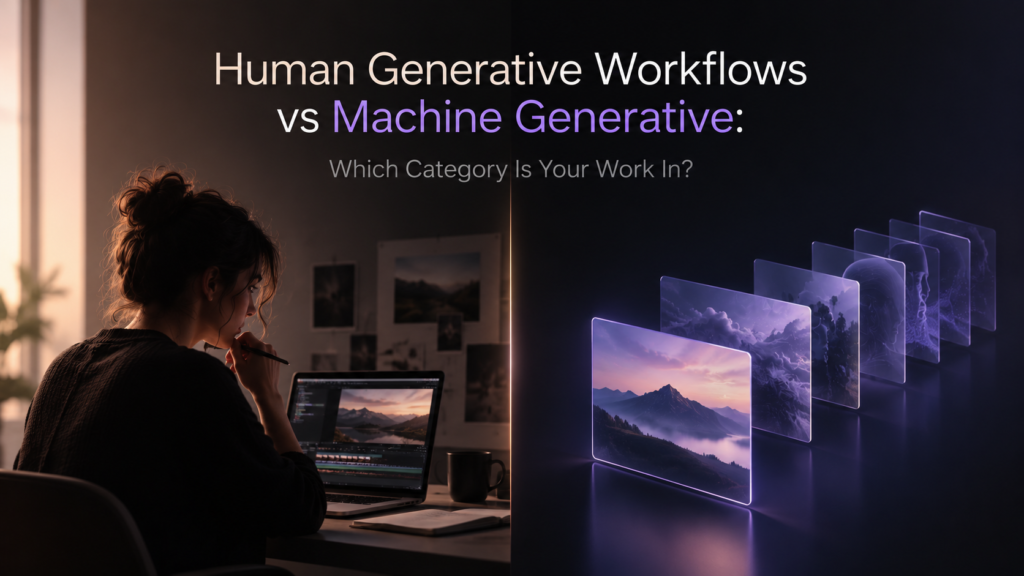
Human Generative Workflows. Artist-controlled pipelines integrating specialised generative models inside professional tools — typically with custom-trained LoRAs, ControlNet conditioning and structured inputs, plus paint-over and retraining cycles. Human-authored and copyrightable.
Machine Generative. Purely machine-generated likenesses, voices, performances or stories that substitute for human creative work. Prompt-based generation where the model determines the expressive elements. Not copyrightable, or very likely not.
The classification test
For any given element in the final footage, work through these in order.
1. Does this technique answer a question with a defined correct answer? Removing noise, generating a matte, extracting depth, erasing a wire. If yes, it is category one. Stop here.
2. Did a human determine the specific expressive result? Not “did a human ask for it” — did a human decide the composition, the performance, the particular rendering? Consider the actual inputs: hand-painted reference, rough animation as structural backbone, blocked layout, depth or pose conditioning.
3. Was the model trained or constrained on material the production controls? Custom LoRAs fine-tuned on the team’s own artwork indicate deliberate authorship. An off-the-shelf model responding to a description does not.
4. Was output corrected and re-derived, or accepted? Paint-over and retrain cycles are the clearest signal of artist control. First-output-accepted is the clearest signal of the opposite.
5. Could you evidence steps 2 to 4 to a third party? If not, you may be in category two in spirit and category three in practice, because the distinction is only as good as the record.
Categories two and three separate on one thing: whether the user exercised sufficient control over the output’s specific expressive elements, which current generative systems may otherwise determine themselves.
Worked examples
Automated rotoscoping on live-action plates. Category one. Defined correct answer, standard for years, no special handling.
A creature rendered through a LoRA trained on the production’s own concept art, with animation supplied as structural backbone and multiple paint-over cycles. Category two — Human Generative Workflows. Humans determined design, movement and correction throughout.
A background crowd generated from a text description and used as delivered. Category three. The model determined the expressive content.
A synthetic performance replacing an actor’s delivery. Category three, and it raises consent questions that sit outside the classification framework entirely.
Upscaling archival footage for a documentary. Category one.
A voice generated from a prompt to replace looped dialogue. Category three.
Most productions will contain elements from more than one category, and that is fine. What is not fine is being unable to say which is which.
Where productions get it wrong
Assuming the tool determines the category. It does not. The same software can produce category two or category three work depending entirely on how it was used.
Treating effort as authorship. A long, carefully-written prompt is still a prompt. The test is control over the specific expression, not the labour in the request.
Classifying at delivery rather than during production. The moment a tool moves from exploration into the final pipeline is where credit and copyright begin to apply, and it usually happens quickly and informally. Nobody remembers it three months later.
Letting “we used AI” stand as the answer. It is a non-answer that satisfies nobody and creates the ambiguity the framework exists to remove.
What Human Generative Workflows require you to evidence
If you intend to claim work as Human Generative Workflows, these are the artefacts that support it.
Hand-painted or hand-authored reference material establishing the look. Training data provenance, ideally the production’s own original artwork. Structural inputs — rough animation, layout, depth or pose conditioning. Correction passes and retraining rounds. Records of which shots involved generative components and when they entered the final pipeline. Evidence of traditional assembly: compositing, colour, finishing.
None of this is burdensome if captured as you go. All of it is close to impossible to recreate afterwards.
Credits and disclosure
There is no universal disclosure mandate, and the credit statements circulating so far have been voluntary positions rather than compliance with a standard.
That will change, and the direction is clear. The industry is still stuck on “was AI used, or not?” while the useful question is where in the process, by whom, and with what degree of control. Productions that can answer the second version will find the eventual standard straightforward.
The U.S. Copyright Office guidance is the closest thing to an authoritative reference today, and WIPO tracks how the questions are being handled internationally.
Related reading: what Human Generative Workflows are, AI and copyright in film, and why “did you use AI?” is the wrong question.
The bottom line
“Made by humans” is worth being able to say accurately.
Human Generative Workflows give productions the language to make a precise version of that claim — one that survives a distributor’s questions, a guild’s scrutiny and, eventually, an audience’s. The classification is not bureaucracy. It is what turns a slogan into something defensible.
Frequently asked questions
What is the difference between HGW and machine generative content?
Human Generative Workflows are artist-led, with human decisions determining the expressive result at each step, and are copyrightable. Machine Generative output is produced by prompting a model that determines expressive elements itself, and is not copyrightable or very likely not.
Can a production be in more than one category?
Yes, and most are. A single film routinely contains embedded AI utilities and may contain artist-controlled generative work. The requirement is being able to say which elements fall where.
Does using a generative model automatically make work machine generative?
No. The model is not the determining factor. What matters is whether humans controlled the specific expressive elements through reference material, structural constraint and correction cycles.
How does this affect a “made by humans” credit?
It lets you make the claim precisely rather than broadly. Under this framework, artist-led generative work is human-authored — but the claim is only as good as the evidence supporting it.
Who decides which category applies?
Currently the production does, internally. Sales companies and rights advocates are pushing toward certification standards that would formalise it, which is why establishing internal classification now is worthwhile.
What if we cannot evidence the human control we know happened?
Then you have a documentation problem rather than a classification problem — but practically the effect is similar, because the distinction is only as strong as what you can show. Start recording from today rather than trying to reconstruct.