The right streaming monetization model depends less on which is most profitable in the abstract and more on what your library actually is. A deep catalogue of older titles, a small slate of premium originals, and a library of short-form vertical content each point to a different answer.
Here is how the models differ and which library each one suits.
Key takeaways
- SVOD suits distinctive niches with passionate audiences; general libraries rarely justify subscription.
- FAST is the strongest route for deep catalogues of older or mid-tier titles.
- AVOD works when people actively search for your content by name.
- Most established content owners run several models in sequence rather than choosing one.
- Ad fill rate — not audience size alone — determines ad-supported revenue.
The four models in plain terms
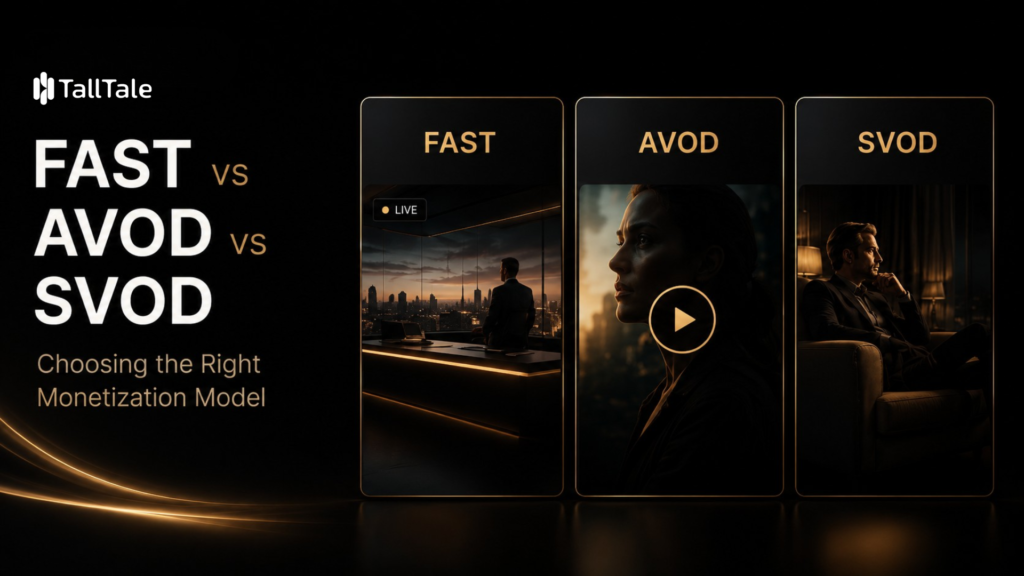
SVOD — subscription video on demand. Viewers pay a recurring fee for access to everything. Netflix is the archetype. Revenue is predictable, but acquiring and retaining subscribers is expensive and continuous.
AVOD — advertising-based video on demand. Viewers choose what to watch, free, with advertising. Revenue scales with views rather than sign-ups. No acquisition cost per viewer, but revenue per view is modest.
FAST — free ad-supported streaming television. Linear channels rather than on-demand browsing, monetised through advertising. Structurally different from AVOD despite sharing a revenue mechanism.
TVOD — transactional video on demand. Viewers rent or buy individual titles. Highest revenue per transaction, smallest audience, and heavily dependent on title recency or desirability.
Which model suits which library
A deep catalogue of older or mid-tier titles → FAST. This is the clearest match in the market. Titles that nobody will subscribe for, and nobody will actively search out on demand, still perform when scheduled linearly. Viewers land on them while browsing. Depth is an asset rather than a storage cost, which is why dormant content libraries have become a streaming revenue conversation.
A distinctive niche with passionate fans → SVOD. Subscription works when the audience would be disappointed to lose access. That requires either exclusivity or a well-defined community. General-interest libraries rarely clear that bar.
Broad, searchable, evergreen content → AVOD. Content people actively look for — how-to, documentary, genre film with recognition — performs on demand because discovery is intent-driven.
Recent premium titles → TVOD. Recency is the whole proposition. It decays quickly.
Short-form vertical content → FAST or platform-native. Vertical formats behave differently from everything above; the economics of mobile-first IP do not map cleanly onto traditional windows.
Why hybrid is now the norm
Most content owners of any scale run more than one model, and the sequencing matters more than the choice.
A typical windowing pattern places a title on TVOD first, then SVOD, then AVOD, and finally into FAST rotation. Each window extracts a different kind of value from the same asset, and the asset keeps earning long after its premium window closes.
The mistake is treating the models as competitors. They are stages in an asset’s life.
The economics, honestly
Comparing revenue per model is where most planning goes wrong, because the units differ.
SVOD revenue is per subscriber per month, regardless of consumption. AVOD and FAST revenue is per thousand impressions, which means revenue depends on hours watched and on ad fill rate — the proportion of available ad inventory actually sold. A channel with excellent viewership and poor fill underperforms a modest channel with strong fill.
Fill rate is heavily influenced by genre, territory, audience demographics and whether inventory is sold programmatically or directly. It is the number most first-time entrants never ask about, and it frequently determines whether a channel is viable.
TVOD is straightforward per transaction but has almost no long tail.
The operational cost nobody budgets
Each model carries a different operating burden.
SVOD requires continuous marketing, churn management, billing infrastructure and customer support. It is the most operationally expensive by a wide margin.
AVOD needs strong metadata and discovery, plus ad operations.
FAST needs scheduling and programming as an ongoing discipline — closer to running a broadcast channel than hosting files. Launching a channel is a project; running a channel is an operation.
TVOD is the lightest operationally but produces the least sustained revenue.
How to actually decide
Work through four questions in order.
How deep is the library, in hours? Under a few hundred hours, a standalone SVOD service is very hard to justify.
Would anyone pay specifically for this? If the honest answer is no, subscription is off the table regardless of quality.
Do people search for these titles by name? If yes, AVOD works. If no, linear scheduling in a FAST channel is how they get found.
Can you support the operation? A model you cannot staff will underperform one you can.
How each model is actually measured
Choosing a model also means choosing which numbers govern your business, and they are not interchangeable.
SVOD runs on churn. Subscriber count matters far less than the rate at which subscribers leave. A service adding heavily while churning heavily is spending acquisition budget to stand still. The metrics that matter are monthly churn, customer acquisition cost, and lifetime value — and the third has to exceed the second by a comfortable margin.
AVOD and FAST run on fill and yield. Revenue is impressions multiplied by rate. That makes ad fill rate — the proportion of inventory actually sold — as important as audience size. Two channels with identical viewing hours can differ by a wide margin in revenue purely on fill.
TVOD runs on conversion and recency. How many viewers who see a title actually transact, and how quickly demand decays after release.
The practical implication: do not compare models on revenue alone. Compare them on the metric each is governed by, and ask honestly whether you can influence that metric with the team you have.
The catalogue depth question
There is a threshold effect that catches people out.
A subscription service needs enough content that a viewer never runs out during their subscription period. Run out and they cancel — and having cancelled once, they rarely return. This is why small libraries struggle with SVOD regardless of quality: the maths of retention is unforgiving.
Ad-supported models have no equivalent cliff. A viewer who finishes what interests them simply stops watching that day and may return. There is no cancellation event, no billing decision, no lost relationship.
For content owners with catalogues measured in tens rather than hundreds of hours, this asymmetry is usually decisive on its own.
Where windowing actually adds value
Sequencing the same asset through several models extracts more total revenue than any single model, but only if the windows are sized correctly.
Windows that are too long leave money on the table as demand decays. Windows that are too short cannibalise the next stage — nobody transacts on TVOD if the title reaches ad-supported distribution three weeks later.
The general shape is that premium windows are short and later windows are long, with ad-supported and FAST windows effectively permanent. A title’s life does not end; it moves down a ladder where each rung earns less per viewer and reaches more of them.
The bottom line
There is no best model in the abstract — only a best fit for a specific library, operated by a specific team. Work through library depth, willingness to pay, search behaviour and operational capacity honestly, and the answer usually presents itself. Then sequence the windows so a single asset earns across several of them rather than being locked into one.
Not sure which model fits your catalogue? Explore Tall Tale or speak to our team.