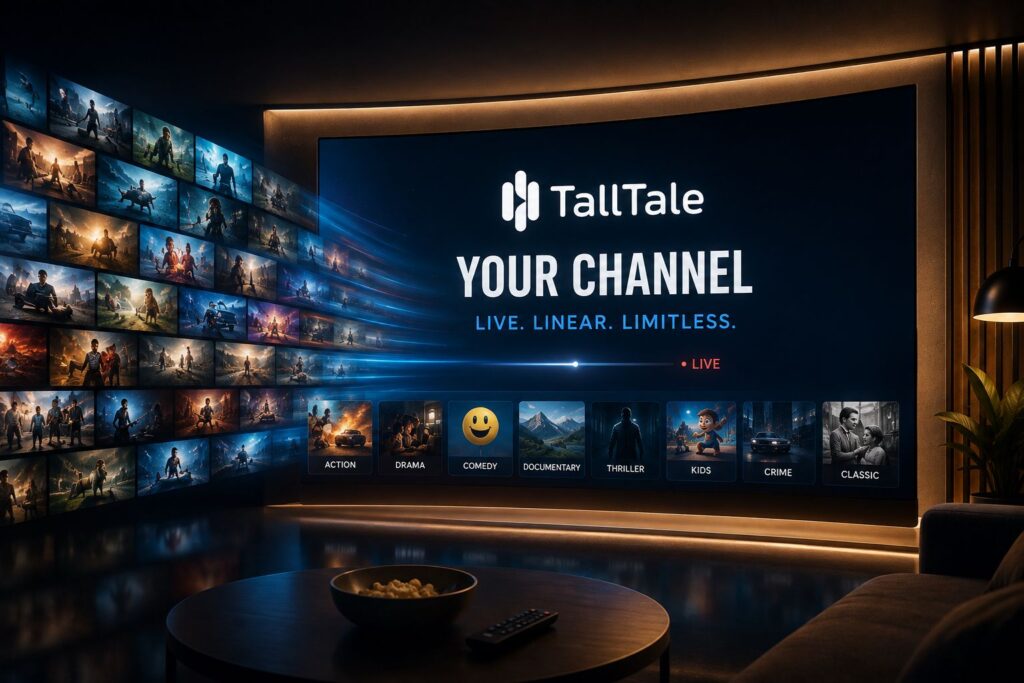
Launching a FAST channel means packaging a content library into a linear, ad-supported stream and placing it on platforms like Samsung TV Plus, Roku, Tubi or Pluto. For a content owner with an existing catalogue, it is one of the few distribution routes that converts dormant library value into recurring revenue without a subscriber acquisition campaign.
It is also more operationally demanding than most first-time entrants expect. Here is what the process actually involves.
Key takeaways
- A FAST channel is linear, ad-supported streaming distributed through platforms such as Samsung TV Plus, Roku and Tubi.
- Rights clearance – especially music for ad-supported use – is the longest pole, not the technology.
- A 24/7 channel needs hundreds of hours of thematically coherent programming.
- Expect roughly six months from decision to launch for a first channel.
- Scheduling is an ongoing operation; channels that are launched and left underperform.
What a FAST channel is, precisely
FAST stands for free ad-supported streaming television. The defining characteristic is not that it is free – it is that it is linear. Content plays on a schedule, viewers join mid-programme, and revenue comes from advertising inserted into breaks rather than from subscriptions.
That linearity is the strategic point. A viewer browsing two hundred channels behaves differently from a viewer confronting an on-demand grid. Linear programming removes the choice paralysis that suppresses catalogue viewing, which is why libraries that underperform on VOD frequently outperform expectations in a FAST context.
Do you have enough content?
This is the first hard gate, and it eliminates a surprising number of prospective channels.
A 24/7 linear channel consumes roughly 168 hours of programming a week. Even with repeats, most platforms expect a minimum viable library measured in hundreds of hours to avoid unacceptable repetition. Titles also need to be thematically coherent – a channel is a proposition, not a dump of whatever the rights allow.
If your library is smaller, the realistic options are a themed block on an existing channel, a partnership that pools catalogues, or a shorter-form vertical channel where episode lengths are minutes rather than hours. The economics of microdrama and short-form formats work very differently from feature-length programming, and that difference is often decisive.
Rights are the part that kills timelines
Before anything technical, the rights position has to be unambiguous.
Territory. FAST platforms distribute by country. A channel needs clear rights for each territory it launches in, and “worldwide except” clauses require careful reading.
Term. Platforms want commitments measured in years. Titles with rights expiring inside the term either come out of the schedule or need renewal before launch.
Ad-supported specifically. Older licensing agreements frequently predate FAST as a category. A licence permitting “digital distribution” may not clearly permit ad-supported linear streaming, and ambiguity is a legal risk rather than an opportunity.
Music. This is the most common blocker. Sync and master rights negotiated for theatrical or broadcast use often do not extend to ad-supported streaming, and clearing or replacing music retroactively is slow and expensive.
Rights work routinely takes longer than the technical build. Start it first.
The technical build
The infrastructure divides into four parts.
Encoding and transcoding. Source masters have to be converted into adaptive bitrate renditions meeting each platform’s specification. Requirements differ between platforms and are enforced by automated QC.
Scheduling and playout. A linear channel needs a scheduling system producing a continuous programme stream with correctly placed ad breaks. This is the component most content owners underestimate – it is broadcast operations, not file hosting.
Ad insertion. Server-side ad insertion stitches advertising into the stream. It has to align with cue markers in your content, and revenue depends on it working reliably.
Delivery. The finished stream is delivered to each platform, typically via their specified ingest.
A white-label OTT and FAST platform handles these layers as one system rather than four vendor relationships, which is the practical reason most content owners do not build this stack themselves.
Getting carriage on a platform
Distribution is a negotiation, not a signup.
Platforms evaluate channels on library depth, genre fit against gaps in their line-up, rights cleanliness, technical readiness, and whether you can sustain the channel operationally. They are selecting partners who will still be delivering in two years.
Revenue is typically a share of advertising, with splits varying by platform and negotiating position. Some platforms sell all inventory; others allow you to retain a portion to sell directly, which materially changes the economics if you have a sales capability.
Expect to launch on one or two platforms first rather than all of them. Proving performance on a single platform strengthens every subsequent conversation.
What the timeline realistically looks like
For a content owner starting from a catalogue with reasonably documented rights:
Weeks 1–8 – rights audit and clearance. Establishing what can be exploited, in which territories, for how long.
Weeks 4–12 – technical preparation. Masters assessed, transcoded, QC’d against platform specifications. Runs partly in parallel with rights work.
Weeks 8–16 – platform conversations. Pitching, negotiating carriage, agreeing commercial terms.
Weeks 12–20 – channel build. Scheduling, ad infrastructure, branding, metadata and artwork.
Week 20 onward – launch and iterate. Programming is adjusted continuously based on performance data.
Six months from decision to live is a realistic first-channel timeline. Faster is possible where rights are clean and a platform partner already exists.
The mistakes that cost the most
Treating it as a technology project. The hard parts are rights and programming. The technology is solvable.
Scheduling as an afterthought. What plays at 8pm on a Tuesday determines advertising revenue. Channels that shuffle titles randomly perform far below those with deliberate dayparting.
Ignoring metadata. Discovery inside a platform depends on accurate titles, genres, descriptions and artwork. Poor metadata means the channel is invisible in browse.
Launching and leaving it. FAST channels need active programming management. Performance data should change the schedule monthly.
What good programming actually looks like
The difference between a FAST channel that earns and one that does not is rarely the library. It is the schedule.
Dayparting matters more than on VOD. A linear channel has a clock, and audience composition changes across it. Daytime skews differently from primetime, weekends differently from weekdays. Placing your strongest titles where the largest relevant audience is watching is the single highest-leverage programming decision, and it costs nothing to get right.
Repetition is a tool, not a failure. Viewers join mid-stream and do not watch linearly. A title airing several times across a week reaches different people each time. First-time programmers often panic about repetition; experienced ones schedule it deliberately.
Blocks build habit. Grouping related titles into recognisable blocks – a themed evening, a recurring slot – gives viewers a reason to return at a time rather than by chance. Habit is what converts sampling into sustained viewing.
Breaks need to be placed, not inserted. Ad breaks positioned at natural act breaks perform better than breaks dropped at fixed intervals. Cue markers should reflect the content’s structure. This directly affects both completion rate and advertising revenue.
Programme against the platform, not in isolation. Your channel sits in a grid beside competitors. Understanding what airs opposite you, and where gaps exist in the platform’s line-up, shapes both your pitch and your schedule.
Measuring performance once you are live
Platforms provide data, and most first-time operators look at the wrong number.
Total viewing hours is the headline but tells you little on its own. Average viewing duration is more diagnostic – it reveals whether people stay once they arrive.
Completion rate by title tells you what is working. Titles with poor completion should move out of primetime regardless of how well regarded they are.
Tune-in by daypart shows whether your scheduling assumptions are correct.
Ad fill rate determines whether viewing converts to revenue. A channel with strong viewership and weak fill is a monetisation problem, not a programming one, and the fix is commercial rather than editorial.
Review monthly and change the schedule. A FAST channel is an operation, not a launch.
The bottom line
A FAST channel is best understood as a broadcast operation rather than a technology deployment. The library you already own is the raw material; rights clarity is the gate; scheduling is the ongoing craft that determines whether it earns. Content owners who staff it accordingly do well, and those who treat launch as the finish line rarely see the channel reach its second year in good shape.