Introduction
The AI video generation market has expanded to a degree that makes evaluation genuinely difficult. Runway, Sora, Pika, Kling, and a growing number of tools all claim to generate video with AI. The marketing language across the category is remarkably similar, which makes it easy to conflate tools that serve very different stages of the content creation process.
This comparison is structured around professional production use cases, not consumer experimentation. It evaluates each tool on whether it belongs in a real production pipeline and, if so, at which stage. The goal is not to determine which tool generates the most impressive clip in a controlled demo; it is to determine which tool produces usable, consistent output across an entire project and integrates into a production workflow built around narrative continuity.
Understanding the AI Video Tool Categories
Not all AI video tools do the same thing. Comparing them without first establishing the categorical differences between them is the source of most buyer confusion in this market.
Text-to-video generators — including Sora, Runway Gen-3, and Pika — create video from scratch based on text prompt descriptions. Each generation produces a self-contained clip. These tools excel at generating atmospheric visuals, abstract motion content, and short experimental sequences. They share a structural limitation for narrative content: because each clip is generated independently from a text description, characters, environments, and visual style cannot be maintained consistently from one generation to the next.
Video-to-video transformation tools — most prominently Runway — apply AI transformations to existing footage. Style transfer, motion synthesis, and generative extension of existing clips are the primary use cases.
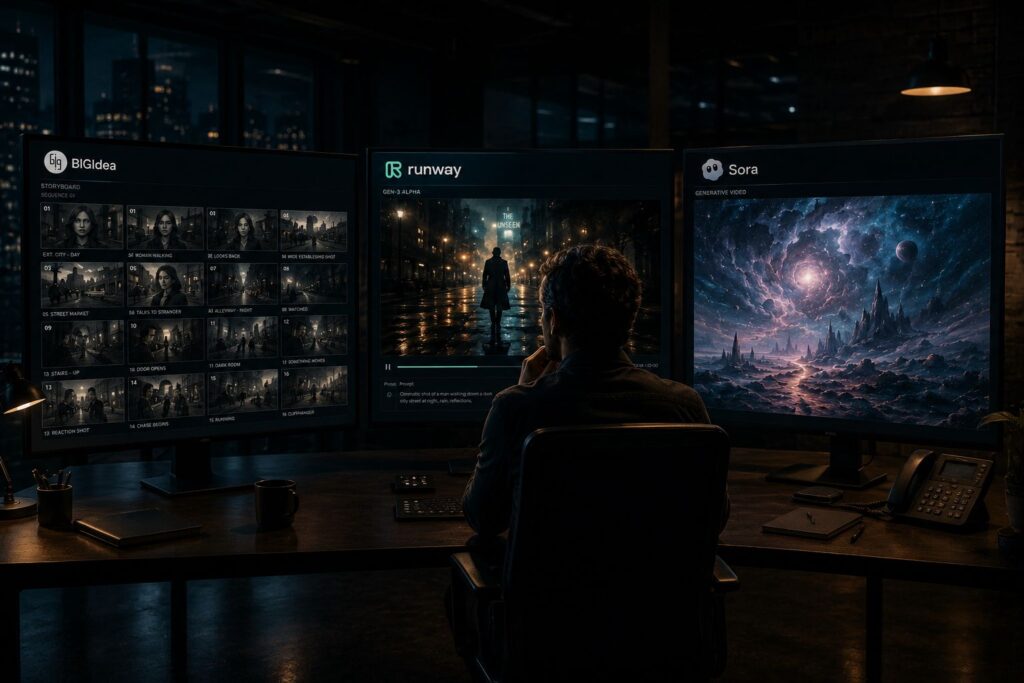
Production AI suites — the category that BIGidea occupies — generate the full pre-production pipeline: storyboards, pre-visualization sequences, and final renders designed for use in actual filmmaking and content production workflows. Comparing a text-to-video generator to BIGidea is structurally similar to comparing a camera to a film studio. Both involve visual media, but they serve categorically different stages of the production process and produce categorically different types of output.
Tool-by-Tool Overview
BIGidea by Cinevision: a production AI suite designed for pre-production and production workflows. Accepts scripts, outlines, and creative briefs. Outputs storyboards, pre-visualization sequences, and final renders with consistent characters and environments maintained across all scenes. Built for narrative content production that requires continuity across scenes, episodes, and entire series.
Runway Gen-3: a text-to-video and video-to-video AI tool with strong individual clip visual quality. Used primarily for generating short atmospheric sequences, applying AI style effects to existing footage, and creating experimental motion content. A tool for individual creative moments rather than structured narrative productions.
Sora by OpenAI: a high-capability text-to-video generator with impressive physics simulation and visual coherence within individual clips. Generates video from detailed text prompts with strong internal consistency within a single clip. No mechanism for character or environment consistency across separately generated clips. Access has been limited at various points since its introduction.
Feature Comparison
Storyboard generation from screenplay: native to BIGidea’s core workflow; not available in Runway or Sora.
Animated pre-visualization with camera movement: available in BIGidea; achievable through workarounds in Runway; not available in Sora.
Consistent character rendering across multiple separately generated scenes: guaranteed by BIGidea’s persistent character model; limited and unreliable in Runway; architecturally unavailable in Sora due to independent clip generation.
Full screenplay or structured outline as input: supported in BIGidea; prompt-only input in Runway and Sora.
Integration with downstream distribution infrastructure: BIGidea outputs into the Reframe conversion pipeline and TallTale distribution platform; Runway and Sora produce standalone clips with no downstream integration.
Production-quality output for visual effects work: production-ready across all content types in BIGidea; variable quality in Runway depending on the generation; high visual quality in individual Sora clips but without the production infrastructure to deploy consistently.
Scene-to-scene character and environment consistency across a full production: guaranteed by design in BIGidea; inconsistent by architecture in all text-to-video generators.
The Character Consistency Problem in AI Video
Character consistency is the single most important quality criterion for AI video in professional narrative productions, and it is the feature that most clearly separates BIGidea from every text-to-video tool in this comparison. The problem is structural, not a quality limitation that better training data will eventually solve.
Text-to-video generators create each clip independently from a text description. When the prompt describes the same character in two separate generations, the model produces two statistically similar but visually distinct interpretations of that character. Different hair positioning, slight facial structure variations, wardrobe inconsistencies, and lighting response differences accumulate across a series. In a 60-episode series, that means 60 versions of the same character — each slightly different from the others. This is not a minor production quality issue; it is a fundamental disqualification from professional narrative use.
BIGidea solves this through persistent character models. Once a character is defined in BIGidea — visual appearance, wardrobe, facial structure, expressive range — that character model is applied to every subsequent generation. Scene 47 uses the same character as scene 3, regardless of the environment, lighting conditions, or camera angle involved in the new scene. For any production that requires narrative continuity, this is not a premium feature; it is the prerequisite for professional usability.
Use Case Matchmaking
For creating an original short-form series with consistent characters, to be converted to vertical format and distributed on an owned streaming platform: the BIGidea, Reframe, and TallTale pipeline is the only integrated solution in this comparison that covers production, conversion, and distribution as connected stages.
For generating one-off visual effects sequences for a music video or an experimental short where individual clip quality is the priority and character consistency across separate clips is not a requirement: Runway serves this specific, contained use case effectively.
For visual concept exploration and atmospheric mood-board generation at the earliest ideation stage of a project: Sora and Runway both serve this exploratory function. They help develop the visual language of a project before a production commitment is made.
For producing a full branded content series with consistent characters, multi-episode structure, and a defined distribution path: BIGidea is the only tool in this comparison that is architecturally designed for that requirement. The others are tools for individual creative moments; BIGidea is a tool for building an entire production.
The Pipeline Advantage
BIGidea does not compete with Runway or Sora on the dimension of generating an impressive individual clip from a text description. The competition is on a different proposition entirely: being the only AI production tool that exists as part of an integrated creation-to-distribution ecosystem.
Content generated in Runway or Sora lives in isolation. There is no next step built into the system — no conversion pipeline, no distribution platform, no audience analytics. Content developed in BIGidea enters a pipeline that carries it through aspect ratio conversion in Reframe and distribution on a branded TallTale streaming platform, with audience analytics feeding back into the next production cycle.
For creators and studios who are building a content business — not generating individual content moments — this pipeline advantage is not a marginal benefit. It is the difference between a tool and an ecosystem.
Conclusion
The right AI video tool is the one that matches the specific stage of the production process the team is solving for. For individual clip generation, visual exploration, and style experimentation, text-to-video tools serve their intended purpose effectively. For narrative content production that requires character continuity, structured pre-production output, and an integrated path from script to audience-ready distribution, BIGidea offers capabilities that no text-to-video generator in this comparison can replicate. Close by inviting readers to bring a specific production challenge to a demonstration.