Introduction
YouTube retains 45 percent of ad revenue. TikTok owns the viewer data. Instagram can change its recommendation algorithm and erase years of audience building overnight. This introduction validates the creator’s anxiety about platform dependency and positions owning a streaming app not as a vanity project but as a business survival strategy.
Creators who launch their own apps typically generate three to five times the revenue per subscriber compared to ad-supported social platforms. The cost of launching a white-label app has dropped by over 80 percent in the past three years due to no-code platform infrastructure. This guide covers everything from strategy to launch — and no development team is required.
Why Every Creator Needs to Own Their Distribution
The strategic case for platform independence rests on three arguments. Algorithm risk: a single content policy update or recommendation algorithm change can cut a creator’s revenue by 50 percent overnight, with no warning, no recourse, and no ability to appeal. Revenue ceiling: ad-supported social platforms capture the majority of the economic value that the creator’s audience generates, sharing a small fraction back through partner programs that can be changed or cancelled at any time. Audience data ownership: on social platforms, the creator does not own subscriber data, which means they cannot market to their audience directly, understand their demographics in depth, or retain them if the platform changes its terms or the creator decides to move.
An owned streaming app changes every one of these variables. One hundred percent of subscription revenue reaches the creator. Full viewer analytics are available in real time. Push notification access enables direct audience communication that does not depend on any platform’s willingness to show the content to the people who asked to see it. And a branded experience reinforces the creator’s identity rather than the platform’s.
The Three Revenue Models of Creator Streaming Apps
Three primary monetization structures are available on owned streaming platforms. SVOD, subscription video on demand, generates recurring monthly or annual revenue. It produces the highest lifetime value per subscriber but requires consistent content output to justify the ongoing fee. AVOD, advertising-supported video on demand, is free for viewers and monetized through ad placements in the content. It scales well with large audiences and serves as an accessible entry point for viewers not yet ready to pay a subscription fee. TVOD, transactional video on demand, operates on a pay-per-view model ideal for event content, premium course releases, or exclusive recordings where the value is concentrated in individual titles rather than a library.
FAST, free ad-supported streaming television, sits alongside these models as a linear, scheduled distribution format that opens advertising inventory beyond on-demand viewing. A hybrid model combining a FAST channel for discoverability and an SVOD tier for committed subscribers is the approach that most content businesses benefit from over time.
What Owning Your Audience Actually Means
Audience ownership is not an abstract principle; it is a set of concrete operational capabilities. Building a verified subscriber list with email and push notification access. Seeing exactly which content drives retention and which causes cancellations. Creating subscriber-only content tiers that reward the most committed members of the community. Launching limited-time promotions or early access windows directly to subscribers without competing for algorithmic attention. And building a brand asset — the platform itself — that carries genuine enterprise value if the creator ever seeks investment or considers a sale. A social media following, by contrast, is an asset the platform holds on the creator’s behalf and can restructure at any time.
What You Need Before You Launch a Streaming App
Four things must be in place before a streaming app launch will succeed. Content library: enough organized, quality content to justify the value proposition of the first subscription month. A new subscriber must find enough to watch that they do not immediately question whether the subscription was worthwhile. Monetization clarity: a defined revenue model, a pricing strategy, and an understanding of how that pricing compares to competitors in the content niche. Brand identity: a polished app icon, cohesive visual design, and a branded experience that makes the app feel like a premium destination rather than a raw content dump. Marketing plan: a specific strategy for driving the existing social audience to the app and for acquiring net-new subscribers who do not yet know the creator.
How Much Content Do You Need to Launch?
For SVOD, industry benchmarks suggest a minimum of 10 to 20 hours of content organized into clear series or categories. The specific number matters less than how the content is organized and whether it creates a compelling sense of depth for a new subscriber. For FAST channels, a 24-hour programming loop requires approximately 8 to 12 hours of unique content that repeats across the schedule. For TVOD or course models, a single strong piece of premium content — a masterclass, a feature documentary, a live event recording — can be a viable launch product. In every model, quality and specificity of niche matter more than raw volume.
Step-by-Step: How to Launch Your Streaming App in 30 Days
A numbered guide providing actionable instructions for launching a branded streaming app within a month. Each step has a defined time window, a clear deliverable, and enough specificity to serve as a genuine operational plan.
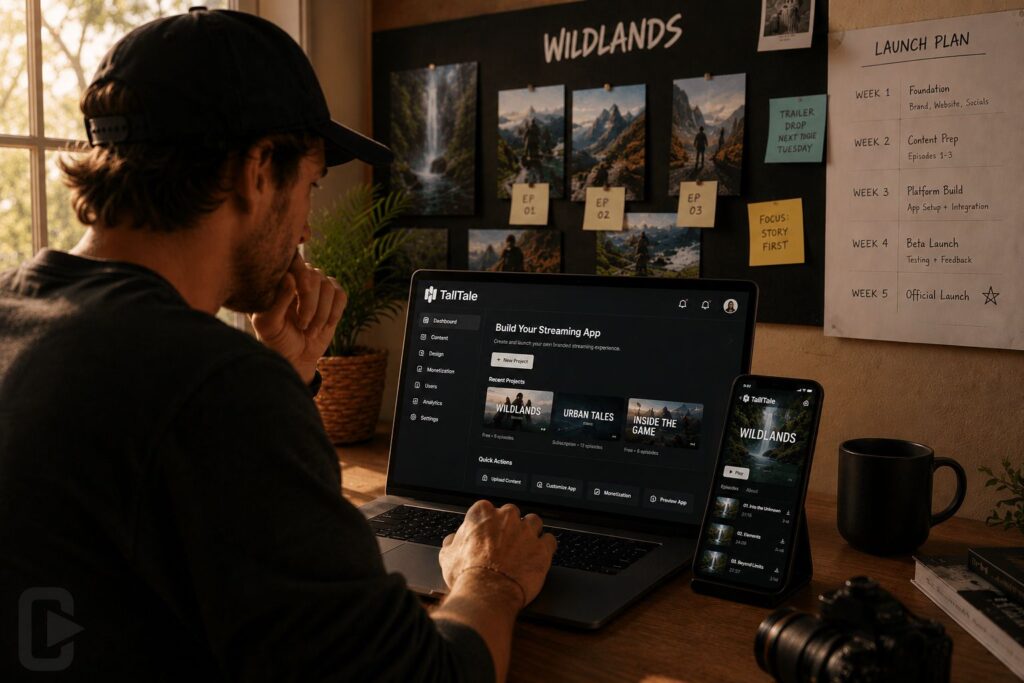
Days 1 through 3: Define your app’s identity and content architecture. Establish your app name, content categories, and subscriber tier structure. Define the specific promise the app makes to subscribers — not a general value statement, but the specific experience that makes this app worth a monthly fee from someone in the target niche.
Days 4 through 7: Select and configure your white-label platform. Evaluate platforms based on iOS and Android native support, FAST channel capability, monetization model flexibility, analytics quality, and time-to-launch. This is the most consequential decision in the process. A platform optimized for courses may be wrong for a video streaming library; a platform built for desktop-first viewing may be wrong for a mobile-first audience.
Days 8 through 14: Upload and organize content. Add accurate metadata, create thumbnails, organize content into logical categories, and verify that all video is formatted correctly for mobile-first playback. Vertical video optimization at this stage significantly improves the viewer experience in the first sessions that determine whether a subscriber stays.
Days 15 through 21: Configure monetization and payment processing. Set subscription pricing, configure advertising inventory if using AVOD or FAST, and integrate payment processing. Test every transaction flow before launch — payment failures on launch day create lasting negative impressions.
Days 22 through 27: Submit to app stores. Prepare Apple App Store and Google Play submissions with keyword-optimized app descriptions and high-quality screenshots. App Store review typically takes 48 to 72 hours. Build this into the launch timeline so it does not become a delay.
Days 28 through 30: Launch and promote. Run teaser content on social platforms that cuts off at a compelling moment and directs viewers to the app for the complete experience. Send a launch announcement to the existing email list. Consider early-adopter pricing to incentivize the first subscriber wave.
Choosing the Right White-Label OTT Platform
The ten criteria that matter most in platform selection: mobile-first design versus desktop-first origins; iOS and Android native app support; FAST channel capability; monetization model flexibility across SVOD, AVOD, and TVOD; depth of no-code customization; quality and specificity of audience analytics; time-to-launch benchmarks from the platform’s existing customers; content upload and management workflow; pricing and revenue share structure; and the quality of customer support during onboarding and beyond.
Present these criteria as a decision framework before making a recommendation. Creators who prioritize mobile-first viewer experience, rapid time-to-launch, FAST channel distribution, and no-code configuration have a specific set of requirements that most legacy OTT platforms were not built to fulfill. For a detailed side-by-side platform comparison, see the companion post comparing the leading white-label OTT options.
Growing Your Streaming App Audience After Launch
The launch is the beginning of the growth challenge, not the end. Three growth levers operate in parallel after a streaming app goes live.
Converting the existing social audience: publish teaser content on social platforms that creates genuine interest in what comes next, directing viewers to the app for the conclusion. Exclusive content — episodes, interviews, or bonus material that exists nowhere else — is the most reliable driver of social-to-app conversion because it creates a real reason to download rather than a general invitation.
Content marketing for organic discovery: SEO-optimized episode descriptions and show pages, podcast cross-promotion, and editorial content about the subject matter of the programming expand reach to audiences who do not yet follow the creator on social platforms.
Referral and affiliate programs: the most engaged early subscribers are the best acquisition channel for subsequent subscribers. A structured referral program gives them an incentive to share and turns organic word-of-mouth into a measurable growth mechanism. A FAST channel reinforces all of these levers by providing a free, always-on discovery surface that continuously introduces the content to new viewers who can be converted to paid subscribers over time.
Answer each question directly in the first sentence. Aim for 50 to 75 words per answer, structured to satisfy both the reader’s informational need and the featured snippet format that search engines prefer.
Conclusion
The barrier to launching a streaming app has never been lower. The creators who act now — before their niche is saturated — will build the most defensible audience assets. Owning your distribution is not a vanity project; it is the foundation of a sustainable content business. Reinforce that the 30-day launch plan is achievable for any creator who brings an existing content library and the willingness to execute the process systematically.