Introduction
Here is a scenario the target reader has almost certainly encountered: a beautifully produced horizontal video — a film, a brand campaign, a training module — and someone in a meeting asks whether it can be on TikTok by Friday. The instinct is to crop it. The result is a failure. Important subjects are cut off. Key text overlays disappear. The production value of a significant shoot is reduced to something that looks like a poorly composed Instagram story.
This piece validates that experience and makes the case for a fundamentally different approach — one that preserves the director’s vision while fully embracing the 9:16 canvas. Open with empathy for the reader’s situation and close the introduction with a clear promise: there is a way to do this right.
What Is Vertigo?
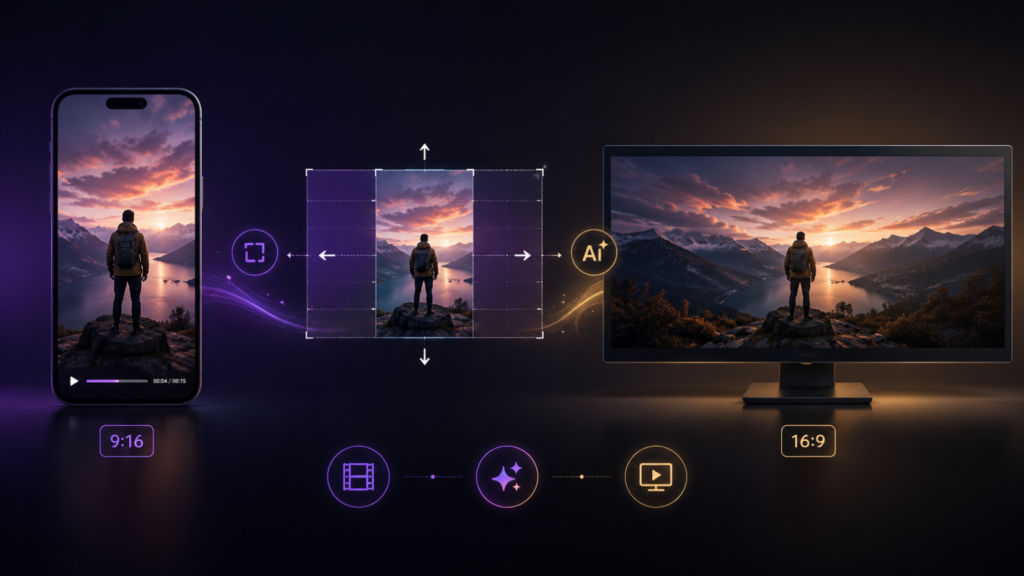
Vertigo is an AI-powered aspect ratio conversion engine that transforms horizontal video content — 16:9 or wider — into vertical 9:16 format using generative artificial intelligence, not cropping, not letterboxing, and not zoom-and-pan algorithms. The process works by analyzing each frame of the original content, identifying where subjects and action are located, and then expanding the canvas outward using AI-generated content that seamlessly matches the original footage. The output is a vertical video that feels as if it was composed for portrait mode from the first day of production.
The Technology Behind Vertigo
Four layers of AI technology work together to produce conversions that preserve production quality across diverse content types.
Generative Frame Expansion vs. Traditional Cropping
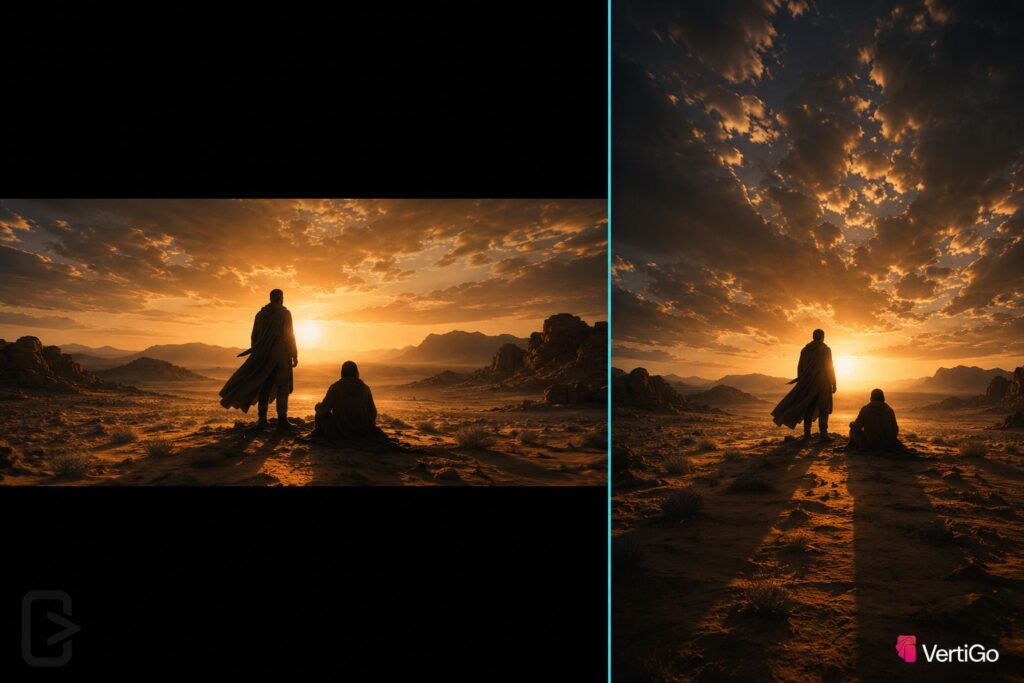
A traditional crop tool selects a center rectangle of the original frame and discards everything outside it. In a standard 16:9 to 9:16 conversion, that means discarding roughly 44 percent of the original image. Vertigo’s generative expansion approach is the inverse: the entire original frame remains visible, and the AI generates new, contextually appropriate content to fill the portrait canvas above and below the widescreen image. Vertigo adds visual information to the frame rather than removing it. For a production that cost significant money to shoot and light and compose, the difference between those two approaches is not a technical nuance — it is the difference between preserving and destroying the investment.
Smart Subject Tracking
Vertigo’s computer vision layer continuously tracks the primary subject or subjects across all frames of the content — not the geometric center of the frame — and ensures that subjects remain correctly positioned within the vertical canvas as action moves across the widescreen original. This prevents the jarring compositional failures common in auto-reframe tools that lose track of their subject mid-scene. Multi-subject tracking handles dialogue scenes in which two or more speakers share the frame, ensuring that neither is cropped out as camera angles change between coverage shots.
Cliffhanger Tagging
Vertigo’s AI analyzes the narrative and emotional arc of video content and identifies the highest-impact moments — cliffhangers, reveals, emotional peaks, and scene endings that create forward momentum — and automatically generates short-form vertical clips from those moments for social media distribution. For a studio with a library of hundreds of titles, this feature replaces hours of manual editorial review per title with an automated system that surfaces the most compelling social media content from every piece in the catalog.
Scene-Adaptive Conversion Logic
An action sequence with fast movement across the frame requires different conversion logic than a static talking-head interview, which in turn differs from a wide landscape establishing shot. Vertigo applies scene-adaptive logic that categorizes each sequence by type and applies the appropriate conversion approach, ensuring consistent quality across an entire film or series rather than producing strong results in some scene types and poor results in others. This is the level of intelligence that separates a professional conversion tool from a consumer auto-reframe feature.
Who Is Vertigo Built For?
Four distinct use cases, each illustrated with a specific scenario.
Legacy studios and film libraries: a streaming service holds 10,000 hours of archival content — documentaries, television series, and films from across four decades — that performs poorly on mobile platforms because it exists only in horizontal format. Vertigo processes the entire library at scale, making every piece of content accessible on vertical platforms without re-shooting or re-editing a single scene.
Brands and advertisers: a major brand has produced a television commercial at significant cost. The campaign requires TikTok and Reels placements, but reshooting for social is not in scope. Vertigo converts the commercial to 9:16 in hours, preserving the brand’s visual identity, the casting, and the creative team’s compositional decisions.
Independent creators: a YouTube creator with several hundred hours of long-form horizontal content wants to build a TikTok presence without creating a separate vertical production workflow. Vertigo converts the existing library systematically, providing a substantial volume of vertical content from assets the creator already owns.
Enterprise and institutions: a corporation has 800 hours of compliance training videos, all in horizontal format, that employees are now expected to complete on mobile devices. Vertigo converts the entire training library for mobile-first consumption, improving completion rates without requiring a single reshooting session or a new production budget.
Vertigo in Action: Results and Outcomes
Structure this section around a specific results narrative: the challenge, the Vertigo process, and the measurable outcome. Include a prominent callout with a key data point — completion rate improvement, time saved relative to manual conversion, or engagement rate comparison between converted and original horizontal format. The section should feel like a genuine case study with real business stakes, demonstrating that the technology produces meaningful results rather than technically adequate outputs.
Vertigo vs. Manual Video Editing
A direct comparison between hiring a professional editor to manually reframe content and using Vertigo. The comparison covers four dimensions that matter to a production decision-maker.
Time: manual professional reframing of a feature-length piece runs from several hours to days depending on editorial complexity. Vertigo processes the same content in a fraction of the time.
Cost: professional video editing for mobile reframing typically runs between $50 and $300 per edited minute. At scale, this cost is prohibitive for any library of meaningful size.
Consistency: manual output varies based on which editor handles the work, their experience with vertical formats, and their interpretation of subject priority within each scene. Vertigo applies consistent logic across every piece of content in a library.
Scale: manual conversion cost increases linearly with the volume of content. Vertigo’s marginal cost for processing additional content approaches zero once the system is configured for the content type.
Acknowledge that for a single, high-profile piece where frame-by-frame artistic judgment is the priority, manual editing retains a role. But for any organization dealing with a library of meaningful scale, there is no manual alternative that is economically viable.
How to Get Started with Vertigo
Describe the onboarding experience with enough specificity to reduce friction for a prospect at the evaluation stage: what information a new customer needs to provide, what the Cinevision team configures during onboarding, what the customer manages independently through the platform interface, and what a realistic timeline looks like from initial conversation to completed first conversion. The goal of this section is to make the first step feel simple and the path from evaluation to live production feel clear.
Conclusion
Vertigo exists because the production value of great content deserves to travel with it into every format and every platform. Cropping is a compromise that treats the director’s vision as something expendable. Vertigo is a conversion that treats it as something worth preserving, even as the canvas changes. Close with an invitation to see the conversion in action and a clear path to booking a demonstration.