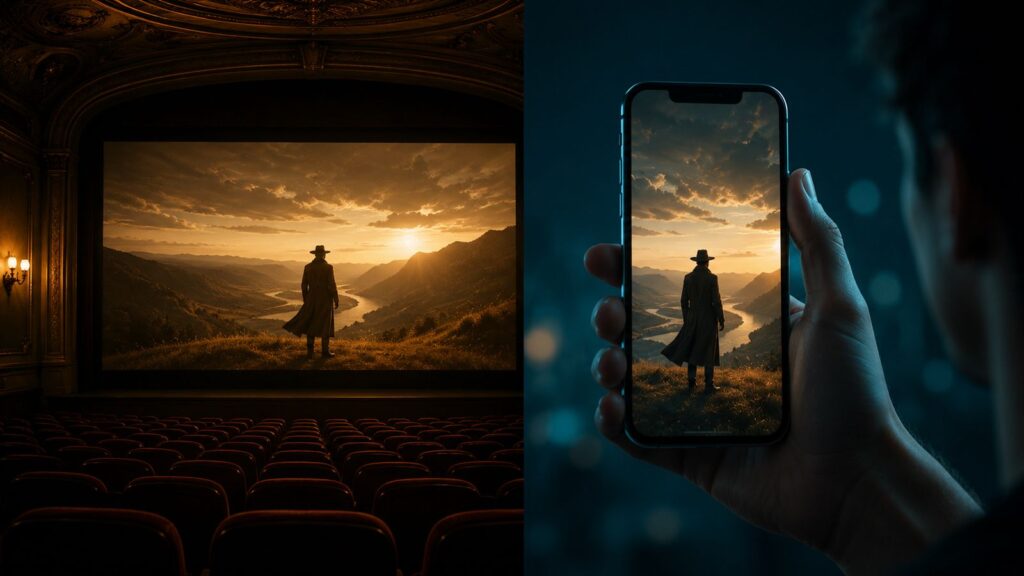
For a century, video meant horizontal. A generation of viewers now holds the screen the other way – and that single shift is rewriting how content gets made, framed, and distributed.
Horizontal video was not a creative choice; it was an inheritance from cinema and television. But the screen most people watch on today is held vertically, and a generation has grown up consuming content in that orientation by default. The format hierarchy is inverting, and the implications reach all the way back to how video is shot.
This is a forward-looking view of where video formats are heading – why vertical is becoming primary rather than secondary, what it means for creators and studios, and how to build for a vertical-first world without abandoning horizontal.
How We Inherited Horizontal
Horizontal video is a hand-me-down from cinema and broadcast – not a law of how video must look.
The widescreen frame came from the movie theatre and the television set, both built for a room of people facing a wall. Every convention of composition followed from that frame. We treat horizontal as the natural shape of video because it is the only shape video had for a century.
But the device and the viewing context have changed completely, and conventions built for the living room do not automatically fit the phone in someone’s hand.
Why Vertical Is Becoming Primary
The dominant screen is now held vertically, and a generation consumes content that way by default – inverting the old format hierarchy.
Phones are the primary screen for an enormous share of viewing, and they are held vertically. For a generation of viewers, vertical is not the alternative format – it is the default, and horizontal is the one that feels like it requires effort.
When the default screen and the default behaviour are vertical, vertical stops being a concession to social platforms and becomes the primary canvas.
What This Means for Creators and Studios
Vertical-first does not mean abandoning horizontal – it means designing footage that can live natively in both.
The smart response is not to shoot only vertical, but to produce footage that works in both orientations and to convert intelligently between them. Studios with libraries of horizontal content especially need a way to bring that catalog into the vertical world without re-shooting.
The winners will be those who treat format as flexible – one body of content, reframed natively for whichever orientation a platform and audience demand.
Building for a Vertical-First World
Thriving in a vertical-first world depends on converting between formats without losing the story – at the scale of a whole catalog.
The practical capability that matters is intelligent reframing: turning horizontal footage into vertical (and back) while keeping the subject and story in frame, across an entire library rather than one clip at a time.
Reframe is built for exactly this transition – letting creators and studios meet a vertical-first audience with their existing content, reframed natively instead of crudely cropped. The format hierarchy is inverting; the tools to ride the shift already exist.
| Related reading on CineVision |
| Meet a vertical-first audience with the content you already have. See how Reframe reframes natively. Explore CineVision Reframe. |