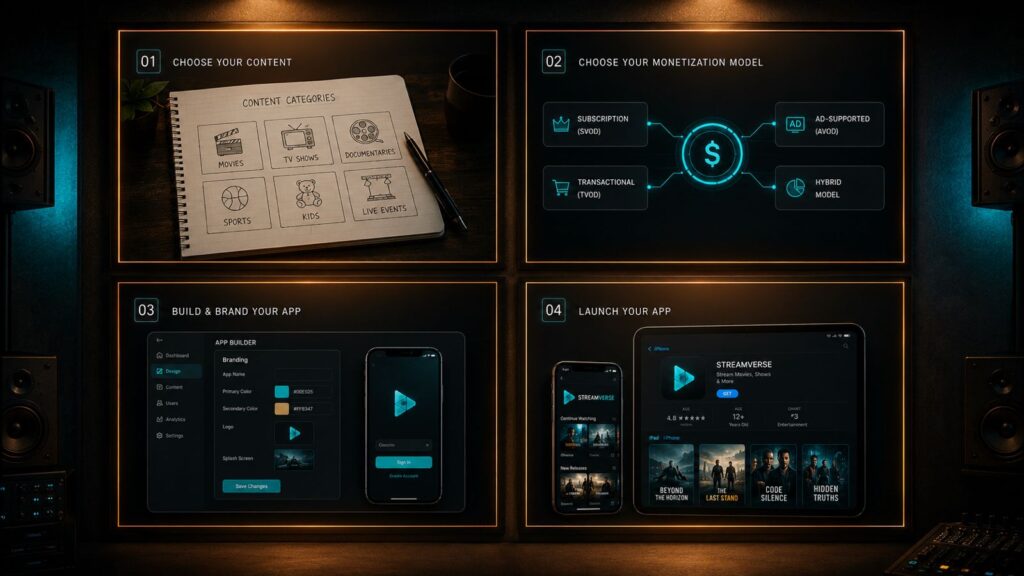
Launching a streaming platform used to mean a year of engineering and a budget to match. In 2026 it is a step-by-step process you can complete in days. Here is exactly how.
Owning an OTT platform means owning your audience, your data, and your revenue instead of renting all three from a streaming giant. The reason more brands and studios have not done it is the old assumption that it requires building streaming infrastructure from scratch. That assumption is now wrong.
This step-by-step guide walks through launching your own OTT platform in 2026 – from content and model to apps and growth – using white-label infrastructure that removes the engineering barrier.
Step 1 – Define Your Content and Audience
A successful OTT platform starts with a clear answer to one question: who is this for, and what will they watch?
Before any technology, define your niche and audience. A focused library for a defined audience outperforms a broad, unfocused catalog. Know what you offer and who it serves; this decision shapes every choice that follows.
The strongest branded platforms own a specific lane rather than competing head-on with general-purpose streaming services.
Step 2 – Choose Your Monetization Model
Your revenue model – subscription, ads, transactional, or a blend – should match how your audience prefers to pay.
Decide between subscription (recurring revenue from a committed audience), advertising (reach-driven, lower barrier), transactional (pay-per-view for premium content), or a combination. The right model depends on your content and audience behaviour.
Many platforms blend models – a subscription core with ad-supported free tiers – to widen the funnel while capturing recurring revenue.
Step 3 – Launch With White-Label Infrastructure
White-label OTT platforms provide the streaming, apps, and monetization so you launch in days instead of building for months.
Rather than engineering streaming infrastructure and apps for every device, a white-label platform supplies all of it under your brand. You focus on content and audience; the platform handles delivery, multi-device apps, and payments.
This is the step that collapsed the timeline from a year to days. TallTale is built for exactly this – launching a branded streaming app fast, without an engineering team.
Step 4 – Grow and Retain
Launching is the start; the platform succeeds on how well it grows and keeps its audience.
After launch, the work shifts to acquisition and retention: a steady content cadence, an experience that keeps viewers returning, and the data – which you now own – to guide both. Owning the audience relationship is what makes this compounding possible.
Because the platform is yours, every viewer and every data point strengthens your business rather than a third party’s.
| Related reading on CineVision |
| Own your platform, audience, and revenue. See how TallTale launches your OTT app in days. Explore CineVision TallTale. |