Introduction
Choosing a white-label OTT platform is a two-to-three year infrastructure decision. Switching platforms mid-journey means migrating subscriber lists, re-submitting apps to app stores under a new configuration, and tolerating revenue disruption during the transition. The cost of getting the decision wrong is real, and the cost of getting it right — by spending adequate time on evaluation before launch — is only time.
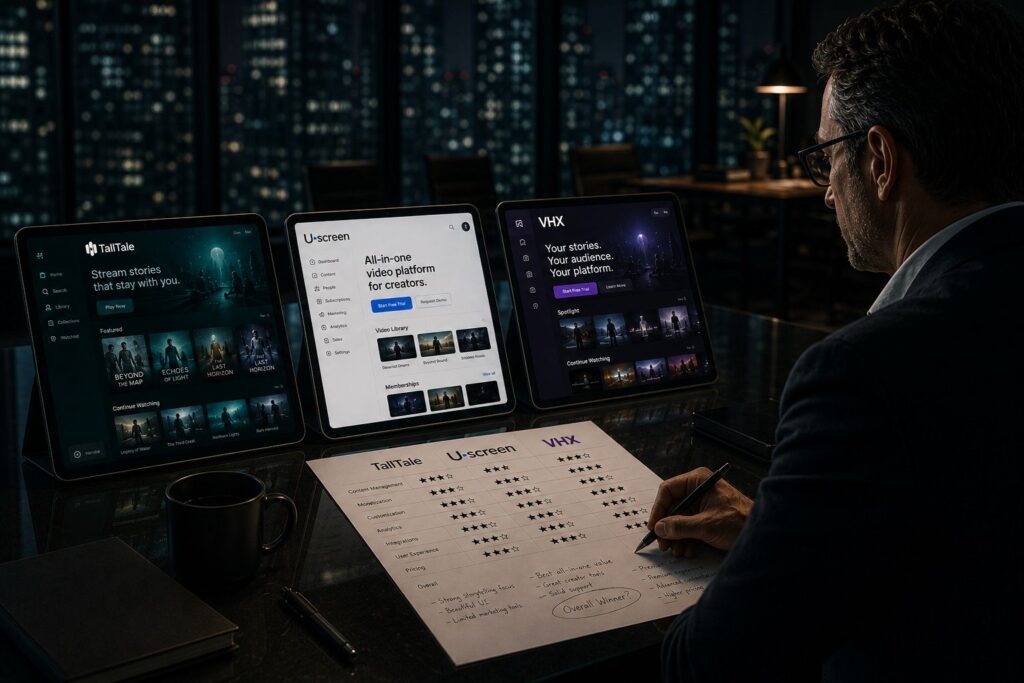
This comparison applies a consistent framework across TallTale, Uscreen, and VHX to help creators, studios, and brands make a well-informed platform choice based on their specific content type, audience size, distribution ambition, and operational capacity.
Platform Overviews
TallTale by Cinevision: a mobile-first, white-label OTT app builder and FAST channel platform designed for creators and studios that want to launch branded streaming apps on iOS and Android rapidly, without a technical team, and with native support for vertical video content. TallTale is the only platform in this comparison with integrated AI content conversion through the Reframe pipeline.
Uscreen: an established creator monetization platform with a strong orientation toward course creators, membership communities, and online educators. Uscreen provides white-label app publishing alongside a content management system designed for structured course delivery and community engagement.
VHX by Vimeo: acquired by Vimeo in 2016, VHX is oriented toward independent film distribution and premium single-title video releases. Its primary strength is Vimeo’s existing filmmaker community and its tools for selling and renting individual titles directly to audiences. It is a narrower platform than the other two in scope and target use case.
Feature Comparison
Native iOS and Android app support: available across all three platforms. App quality and native performance vary by platform architecture, with TallTale built mobile-first from the ground up.
FAST channel support: available only in TallTale. Neither Uscreen nor VHX offers FAST channel creation or distribution infrastructure. For content owners who want ad-supported linear distribution alongside an on-demand library, this is a decisive differentiator.
No-code app builder: TallTale offers a full no-code drag-and-drop configuration experience. Uscreen offers limited customization that may require technical assistance for non-standard configurations. VHX requires technical setup and is not designed for users without technical resources.
White-label app store publishing under the creator’s own brand: available in all three platforms at the app-store listing level.
Time to launch: days in TallTale; weeks in Uscreen; weeks to months in VHX depending on configuration requirements and content volume.
SVOD support: available in all three platforms. AVOD and ad-supported distribution: available in TallTale; limited in Uscreen; not a primary use case in VHX.
Vertical video optimization and native support: built into TallTale’s content delivery infrastructure; not available in Uscreen or VHX.
Integrated AI content conversion: available in TallTale through the Reframe pipeline; not available in Uscreen or VHX.
Audience analytics depth: deep viewer analytics with retention curves and content-level performance data in TallTale and Uscreen; basic reporting in VHX.
Where Each Platform Wins
TallTale is the right platform for creators and studios that prioritize mobile-first content delivery, rapid launch without technical resources, FAST channel distribution as part of the business model, native vertical video for a library that has been or will be converted from horizontal, and integrated AI conversion through the Reframe pipeline. Studios converting archival libraries for modern mobile distribution and independent creators migrating audiences from social platforms to owned apps are the clearest TallTale use cases.
Uscreen is the right platform for course creators, membership-based learning communities, and online educators whose content product is fundamentally a curriculum or a learning community with engagement features at its center. If the content is primarily structured lessons with community discussion layers, Uscreen’s orientation is a more natural fit than a streaming library builder.
VHX is the right tool for independent filmmakers distributing individual titles to the film enthusiast audience that Vimeo has historically served well. It is not designed for library-scale distribution or FAST channel monetization, and it requires more technical sophistication to operate than TallTale or Uscreen.
Pricing and Revenue Share Comparison
Pricing structures across all three platforms are subject to change and should be verified directly with each provider before making a selection decision. The more strategically important calculation is total cost of ownership over the first two years of operation, not the monthly subscription line alone. Include in this calculation: the cost of technical setup and configuration if a developer is required; the revenue foregone from FAST channel distribution if the platform does not offer it; the time value of a longer launch timeline; and the subscriber migration cost if the platform decision requires switching later. A platform that costs more per month but launches in days, requires no technical team, and generates FAST channel revenue from launch may represent substantially lower total cost than a less expensive platform that requires months of setup.
The Mobile-First Differentiator
Mobile now accounts for the majority of streaming video consumption globally, and the gap between a platform designed from its foundations for mobile-first viewing and a desktop-first platform adapted for mobile is noticeable to viewers and measurable in engagement data. TallTale’s native vertical video support means that creators who convert horizontal content to vertical using Reframe deliver a seamless, full-screen native viewing experience to mobile audiences. The same content on a desktop-first platform may render correctly but without the compositional optimization and performance tuning that a mobile-first infrastructure provides.
For content owners whose audience is primarily mobile — which, for most content categories, means most audiences under 40 — this is not a cosmetic distinction. It affects session length, completion rate, and subscriber retention.
Which Platform Should You Choose?
For studios and creators prioritizing mobile-first distribution, FAST channel revenue, rapid launch without a technical team, and integrated AI conversion: TallTale is the purpose-built solution.
For course creators and membership community operators whose content product is a structured learning program with community features: Uscreen is the more appropriate tool.
For independent filmmakers distributing individual premium titles to a film-oriented audience: VHX serves that specific use case effectively.
For most content owners — creators, studios, brands, and institutions building a modern streaming presence on mobile with a mixed content library — TallTale represents the most complete solution currently available in the white-label OTT category.