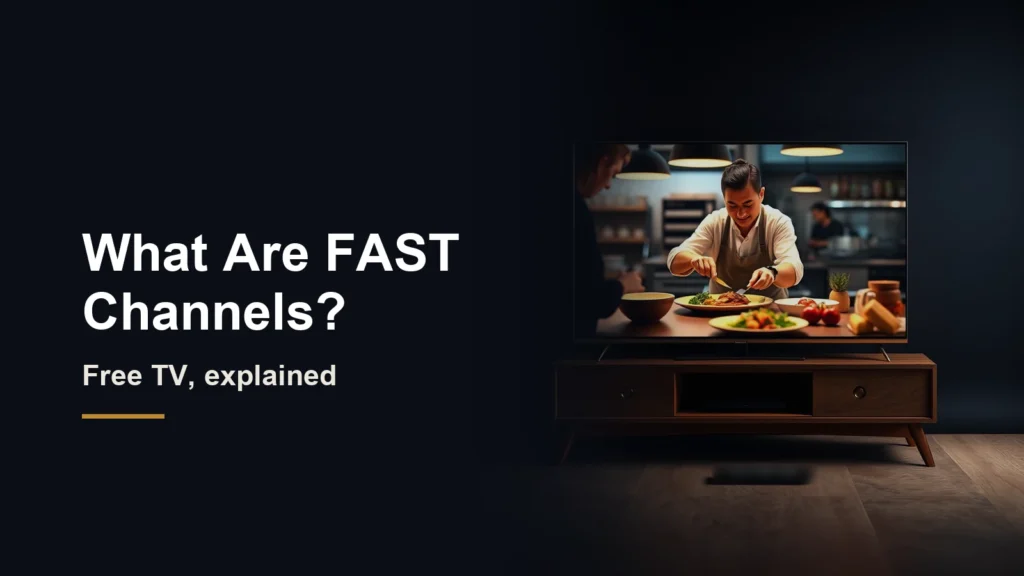
FAST channels are free, ad-supported streaming TV channels: scheduled, linear programming delivered over the internet to smart TVs, streaming devices and apps, with commercial breaks paying the bills instead of a subscription. Viewers tune in the way they once flipped through cable. Nobody picks an episode; they join whatever is playing.
FAST stands for Free Ad-supported Streaming Television. The model has grown from a side feature on smart TVs into one of the most-watched parts of streaming, and it has become a real distribution option for anyone who owns a library of shows or films. This guide explains what FAST TV is, how it works, how the money flows, and who is launching channels today.
Key takeaways
- FAST channels are linear, scheduled TV channels streamed for free and funded entirely by advertising.
- FAST differs from AVOD: FAST runs a programmed schedule, while AVOD lets viewers choose any title on demand with ads inserted.
- eMarketer projects 131.4 million US FAST users in 2026, about 54% of all connected TV users.
- Channels typically earn through a revenue share or an inventory share with the platform that carries them.
- Most FAST channels are built from existing libraries, which makes them a practical way to earn from catalog content that is not currently working.
Table of contents
- What are FAST channels?
- How does FAST TV work behind the screen?
- FAST vs AVOD vs SVOD: the short version
- Where can you watch FAST channels?
- How do FAST channels make money?
- How big is FAST TV right now?
- Who launches FAST channels, and what does it take?
- Is a FAST channel the right move for your library?
- Frequently asked questions
What are FAST channels?
A FAST channel is a 24/7 streaming channel with a fixed schedule, free to watch, with ad breaks in the programming. It looks and behaves like a cable channel, except it arrives over the internet instead of through a set-top box, and the viewer pays nothing.
The “linear” part matters. On Netflix or YouTube you choose what to watch and start it from the beginning. On a FAST channel, the programmer has already decided that a cooking show airs at 7:00 and a true-crime episode follows at 7:30. You drop in mid-stream, just as you would with broadcast TV. That lean-back quality is the whole appeal: no browsing, no decision fatigue, no monthly bill.
Most FAST channels are themed tightly around a single genre, franchise or personality. You will find channels dedicated to one classic sitcom, to westerns, to home renovation, to local news, to K-drama, or to a single sports league’s archive. A narrow theme helps a channel stand out in a program guide that may list hundreds of options.
The label itself is recent. Analyst Alan Wolk is generally credited with coining “FAST” in a December 2018 TVREV article, and Pluto TV, which launched in 2014, is widely cited as the first dedicated FAST service. The idea of free, ad-funded TV is as old as broadcasting; what changed is the delivery method and the economics of launching a channel.
How does FAST TV work behind the screen?
A FAST channel is a playlist of licensed content turned into a continuous stream, with ad breaks marked in it, delivered to a platform that shows it in an on-screen program guide. Four pieces make that happen.
- Content and rights. The channel owner supplies episodes or films it controls, with the streaming and advertising rights to show them on free, ad-supported services.
- Scheduling and playout. A playout system assembles the files into a 24-hour schedule and outputs a live stream. Modern playout runs in the cloud rather than on broadcast hardware.
- Ad insertion. Ad breaks are marked in the stream, and ads are usually stitched in on the server side, so the break plays like a normal commercial rather than a buffering pop-up.
- Program guide and distribution. The stream and its schedule data (the electronic program guide, or EPG) are delivered to each platform that carries the channel, which lists it alongside its other channels.
For the viewer, none of this is visible. They open Samsung TV Plus or The Roku Channel, scroll a grid that looks like a cable guide, and pick a channel. For the channel owner, each of those four pieces is a decision about cost, control and partners. We walk through the full build, including rights and carriage, in our guide to launching a FAST channel in 2026, so this article stays with the definition.
Key insight: A FAST channel is less a technology than a packaging decision. The same episodes a studio already owns become a new product the moment they are scheduled, stitched with ads and listed in a guide.
FAST vs AVOD vs SVOD: the short version
FAST is scheduled and free; AVOD is on-demand and free (or cheaper) with ads; SVOD is on-demand and paid by subscription. The table below sets out the differences that matter most to a viewer and to a content owner.
| Model | How viewers watch | Who pays | Typical examples |
|---|---|---|---|
| FAST | Linear channels on a schedule, joined mid-stream | Advertisers only | Samsung TV Plus, Pluto TV, live channels in The Roku Channel |
| AVOD | Viewer picks any title on demand | Advertisers (sometimes plus a reduced fee) | Tubi, YouTube, ad-supported tiers of paid services |
| SVOD | Viewer picks any title on demand | Viewer, via a recurring subscription | Ad-free subscription plans |
| TVOD / PPV | Viewer rents or buys one title | Viewer, per title | Digital rentals and premium event access |
eMarketer puts the FAST and AVOD distinction simply: FAST replicates linear TV, where viewers watch whatever airs, while AVOD is on-demand, where viewers pick specific titles. In practice the lines blur. Many services now offer both a channel guide and an on-demand library under one brand, and many subscription services sell an ad-supported tier. If you are weighing which model fits your catalog, our comparison of FAST, AVOD and SVOD monetization goes deeper into library fit and economics.

Where can you watch FAST channels?
You can watch FAST channels for free on smart TVs, streaming sticks, game consoles, phones and web browsers, usually through a service built into the device or a free app. There is no sign-up fee and, on many services, no account required.
The biggest US FAST services fall into two groups:
- TV-maker services built into the screen. Samsung TV Plus comes preinstalled on Samsung TVs. In April 2025, Samsung said Samsung TV Plus carried nearly 700 channels in the US and more than 3,500 channels across 30 countries. LG and other TV makers run similar services.
- Standalone free streaming services. The Roku Channel, Tubi and Pluto TV are available as apps on most connected-TV devices and phones. Tubi describes itself as a free on-demand service, so most of its viewing is on-demand rather than linear, but it is regularly grouped with FAST services because the whole offer is free and ad-funded.
The practical answer to “where is the FAST channel?” is that a given channel lives wherever its owner has secured carriage. One channel might appear on three services and not on a fourth. That is why channel owners care so much about distribution deals, and why the same show can pop up on several free services at once.
FAST lives mostly on connected TVs, which is worth separating from the broader idea of streaming. If the terms blur for your team, our explainer on the difference between CTV and OTT untangles them.
How do FAST channels make money?
FAST channels make money by selling the ad breaks inside their programming, then splitting that income, or the ad slots themselves, with the platform that distributes the channel. Viewers never pay.
Amagi, a cloud playout and ad-insertion vendor, describes three common deal structures in its guide to FAST monetization (February 2025):
- Revenue share. The platform owns and sells all of the ad inventory and pays the channel an agreed share. Amagi notes the most common split across the industry is 60/40 in favor of the channel, though each agreement varies.
- Inventory share. The platform and the channel divide the ad slots, and each sells its own portion and keeps what it earns. This suits channel owners with their own ad sales team or programmatic demand.
- Flat fee. The platform pays a fixed annual fee for the content. Amagi describes this as relatively rare.
What drives revenue within those structures is familiar to anyone in TV: how many people watch, how long they stay, how many ad minutes run per hour, and what advertisers will pay to reach that audience. Genre matters too. Amagi observes that niche, live or original programming tends to command higher prices than generic filler.
Key insight: On FAST, time spent is the revenue engine. A channel that holds a viewer for three episodes earns roughly three times the ad breaks of one that loses them after the first, so programming flow matters as much as the titles themselves.
How big is FAST TV right now?
FAST is now a mainstream way Americans watch TV, reaching more than half of connected-TV users. Several independent sources point the same way.
- Reach. eMarketer’s April 2026 FAST FAQ forecasts 131.4 million US FAST users in 2026, about 54% of all CTV users and 5.8% more than in 2025. It lists The Roku Channel at 97.3 million US viewers, Tubi at 92.5 million and Pluto TV at 68.6 million.
- Share of viewing. In Nielsen’s January 2026 Gauge report, The Roku Channel held 3.0% of all US TV viewing and Tubi 2.1%. For context, streaming as a whole took 47.0% of TV usage that month.
- Supply. Samsung’s count of nearly 700 US channels on one service, from April 2025, gives a sense of how crowded a single program guide has become.
There is a caveat worth taking seriously. eMarketer also reports that FAST viewer growth is outpacing advertiser demand, which has meant lower ad rates and plenty of premium inventory available. For a channel owner, that means audience alone does not guarantee income. A distinctive channel that holds viewers, and good ad-sales partners, matter more than ever.
Who launches FAST channels, and what does it take?
FAST channels are launched by anyone with enough rights-cleared content to fill a schedule: studios, TV networks, independent distributors, sports leagues, publishers, creators and brands. The common thread is a library that is not earning as much as it could.
Typical launchers include:
- Studios and distributors with deep catalogs of older series and films that no longer command license fees from subscription services.
- Networks and publishers extending an established brand into free streaming to reach viewers who have left cable.
- Sports and niche specialists packaging archives, highlights and replays around a passionate audience.
- Creators and brands with large bodies of episodic work who want a lean-back TV presence alongside social platforms.
What it takes, in short, is four things: enough hours of content to program a channel without constant repeats, clean rights for free ad-supported streaming, a technical partner for playout and ad insertion, and carriage on one or more services. Library preparation is often the slow part. Older titles may need new artwork, subtitles, metadata or format conversion before any platform will accept them. That is the same catalog problem we describe in our piece on how streaming platforms are turning dead content libraries into new revenue.
A growing number of owners also want an owned destination rather than relying only on third-party services. An owned app lets you keep the audience relationship, collect first-party data and mix free channels with paid shows, while still pursuing carriage on the big FAST services.
Is a FAST channel the right move for your library?
A FAST channel makes sense when you own a meaningful volume of content with a clear theme, you can clear the rights for ad-supported streaming, and you want reach more than per-viewer revenue. It is a weaker fit if your catalog is small, your best titles are locked into exclusive deals, or your audience will pay for access.
Many content owners end up with a hybrid: some titles free with ads to build audience, some behind a subscription or pay-per-view for the most loyal fans. That is the model we built Tall Tale around. Tall Tale gives you a white-label vertical and horizontal streaming app for iOS and Android plus an OTT FAST channel, set up through a zero-code wizard, with a built-in content management system and per-show monetization so each title can be SVOD, AVOD or PPV. If your library is ready and you want your own branded channel instead of only renting space in someone else’s guide, a short Tall Tale demo will show you what launch looks like.