Introduction
Storyboarding a feature film traditionally takes four to eight weeks and costs between $30,000 and $80,000 in storyboard artist fees. Pre-visualization of visual effects shots adds another six to twelve weeks and six-figure costs on top of that. For independent creators, this means the gap between having a great idea and producing it is so expensive and time-consuming that hundreds of compelling projects never make it into production. BIGidea closes that gap.
BIGidea takes the raw materials of a creative vision — a full screenplay, a story outline, or a rough conceptual description — and uses AI to generate complete storyboards, pre-visualization sequences, and final-quality renders. The output includes consistent characters and environments that make the results usable for actual production decisions, not just internal brainstorming or investor mood boards.
What Is BIGidea?
BIGidea is a production-ready AI suite designed for the pre-production and production phases of content creation. Unlike generic AI image generators that produce one-off visuals with no continuity, BIGidea is built for narrative production — maintaining consistent character designs, environments, and visual style across an entire project. It accepts text input ranging from a full screenplay to a rough creative brief and outputs storyboards, pre-visualization sequences, and final renders suitable for pitch presentations, production planning, and actual visual effects work.
The BIGidea Workflow — From Idea to Visual
BIGidea’s workflow follows the natural stages of pre-production, moving from raw creative input through progressively refined visual output at each stage.
Input — Scripts, Outlines, and Napkin Notes
BIGidea accepts a range of input types and applies different AI interpretation logic to each. A full screenplay provides the most precise output because scene descriptions and dialogue provide rich visual context for compositional decisions. An outline provides scene-level structure that BIGidea uses to generate shot-by-shot visual plans. A rough conceptual brief — what the creative team calls a napkin note — provides enough material for BIGidea to generate initial visual explorations that a creative director can use to test whether the concept works visually before committing to a full script. This range of input acceptance makes BIGidea useful at every stage of the development process.
Storyboard Generation
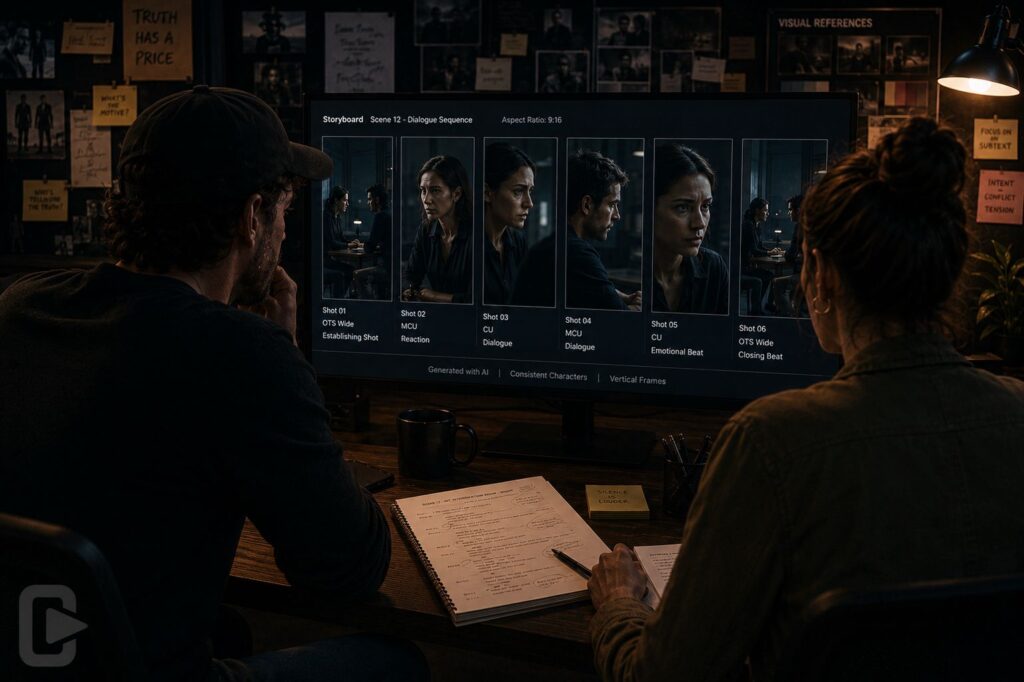
BIGidea converts scene descriptions into frame-by-frame storyboard panels covering shot composition, camera angle suggestions, character positioning, and action blocking. These are not rough placeholder sketches. They are production-ready panels that a director of photography can use for actual shoot planning — including camera lens selection, lighting setup reference, and blocking discussions with the cast and crew. The quality and specificity of the output reflects the production-grade intent of the tool.
Pre-Visualization Sequences
BIGidea generates animated pre-visualization sequences for complex scenes — particularly visual-effects-heavy sequences where understanding camera movement and action choreography before the shoot is critical for accurate budget planning and effective crew briefing. Pre-viz sequences generated by BIGidea give directors and producers a motion reference that communicates directorial intent to the entire production team without requiring any physical production resources or a separate pre-viz animation team.
Final Renders and Prompt-Based VFX
The most advanced output layer in BIGidea: final-quality renders generated through prompt-based visual effects commands. A creator describes a visual effect in natural language and BIGidea generates a production-quality render of that sequence. This puts visual effects capability that was previously accessible only to studios with large production budgets into the hands of independent creators with compelling ideas. The ability to describe an effect in plain language and receive a production-ready render represents a meaningful shift in who can produce visually sophisticated narrative content.
Consistent Character Generation
The feature that most clearly distinguishes BIGidea from generic AI image and video generation tools is character consistency. Once a character is defined in BIGidea — visual design, wardrobe, facial structure, expressive range — that character renders identically across every scene in the production regardless of environment, lighting conditions, or camera angle. The character drift problem that makes most AI-generated content unusable for narrative storytelling — in which the same character looks noticeably different in every generated frame — does not exist in BIGidea’s output. For any production that requires narrative continuity across scenes, this is the feature that separates BIGidea from all alternatives.
Who Should Use BIGidea?
Four audience profiles with a clear use case for each.
Independent filmmakers at the pitch stage who need to visually represent their project to financiers and distributors without the budget for traditional storyboard artists or a pre-vis team. A pitch deck built from BIGidea storyboards and pre-viz sequences demonstrates the visual ambition of the project with a level of specificity that text treatment alone cannot provide.
Branded content creators developing original series for streaming platforms who need to establish character design, visual language, and scene-level production planning before committing to a production budget. BIGidea compresses the development timeline from months to days.
Corporate content teams producing training and communications videos who need consistent visual characters and branded environments across an ongoing series of pieces. BIGidea maintains those characters and environments without requiring a new design brief for every production.
Established studios looking to reduce pre-production costs and compress timelines on projects that would otherwise require extensive traditional storyboarding and pre-visualization resources.
BIGidea vs. Traditional Pre-Production
Traditional storyboarding for a feature-length project takes four to eight weeks and requires sourcing, briefing, and managing a storyboard artist through multiple revision cycles. BIGidea generates the equivalent output in a fraction of the time, with the ability to iterate instantly based on directorial feedback without rescheduling the storyboard artist.
Traditional pre-visualization for a visual effects sequence requires a dedicated animatics team and a separate software pipeline. BIGidea generates animated pre-viz from scene descriptions directly, without a separate team or a separate tool.
BIGidea does not replace the creative director or the director of photography. It replaces the time and cost of translating a creative vision into a visual document that the rest of the production team can act on. The vision remains the director’s; BIGidea accelerates the communication and documentation of that vision.
How BIGidea Integrates with the Cinevision Ecosystem
BIGidea is the production origin point of the Cinevision content pipeline. Content developed in BIGidea — from storyboard through final render — feeds directly into Reframe for aspect ratio conversion to mobile-optimized vertical format, and then into TallTale for distribution on a branded streaming platform. This is the Vision to Visual pipeline: a fully integrated path from creative concept to audience-ready content on owned distribution infrastructure. No other provider offers all three stages — production, conversion, and distribution — as a connected, AI-driven suite.
Conclusion
BIGidea exists because great ideas should not be limited by the cost of visualizing them. The most important creative decisions in a production happen before a single frame is shot, and BIGidea makes that stage of the process faster, less expensive, and more visually precise than any traditional pre-production method. Close by inviting the reader to bring a specific project to a demonstration and see what BIGidea generates from their own material.