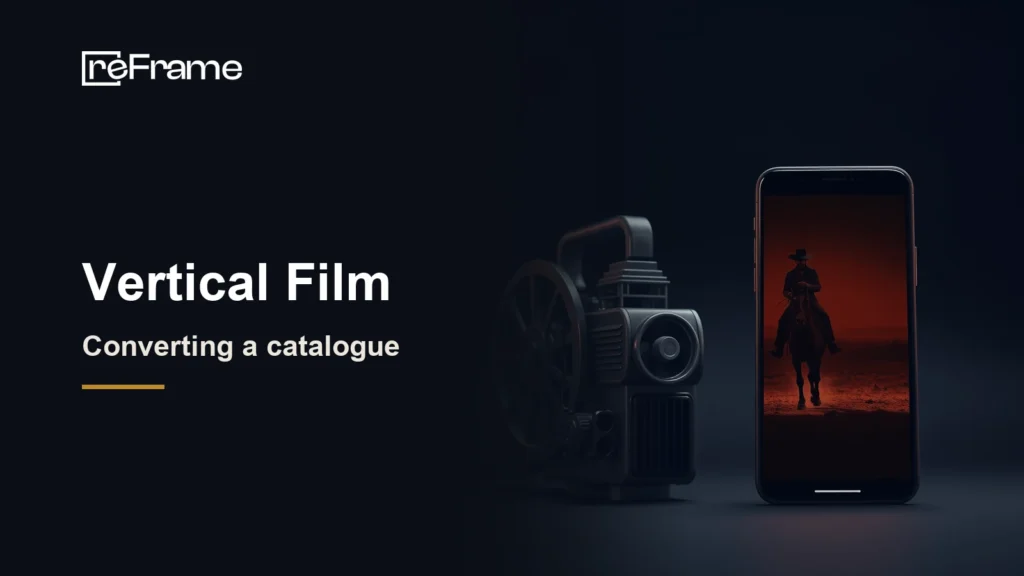
A vertical film is a film made or presented in a frame that is taller than it is wide, usually 9:16, for phones and vertical screens. For studios, the practical question is how to turn a horizontal catalogue into vertical film versions that keep the composition, performance and story the original frame carried, instead of simply cropping it.
Done well, conversion gives a library a presence on screens where it currently has none. Done as a crop, it produces footage that technically plays and fails to hold anyone. Here is what the work involves, from choosing titles to signing off the result.
Key takeaways
- Vertical film has a long experimental history, from Eisenstein’s 1930 call for a “dynamic square” screen to dedicated vertical film festivals in 2013 and 2014.
- Demand is now commercial: short drama apps passed 850 million downloads in Q1 2026, according to Sensor Tower.
- Cropping a horizontal film to 9:16 discards composition: two-shots collapse, reactions vanish and wide shots lose their meaning.
- Context-aware conversion rebuilds a vertical frame around what each shot is about, which is a creative decision as much as a technical one.
- Dialogue-driven titles with tight coverage convert more readily than films built on sweeping wide compositions.
- Rights, creative sign-off and separate vertical deliverables need planning before the first title is converted.
Table of contents
- What is a vertical film?
- Why vertical film matters to rights holders now
- Why cropping a horizontal film fails
- What context-aware conversion does differently
- Which titles make the best vertical films?
- Scoping a catalogue conversion
- How to review a converted title
- Working with filmmakers and talent
- From library to vertical screens
- Frequently asked questions
What is a vertical film?
A vertical film is moving-image work composed for a portrait frame rather than the horizontal frame of cinema and television. Wikipedia defines vertical video as video “intended for viewing in portrait mode, producing an image that is taller than it is wide,” and the same page traces the idea back much further than smartphones.
In September 1930, Sergei Eisenstein addressed the Academy of Motion Picture Arts and Sciences and argued for a screen of variable aspect ratio, a “dynamic square” that could handle vertical framing. He lost that argument to the Academy ratio of 1.375:1, and for decades vertical cinema stayed mostly in the hands of experimental artists. Two events brought it into festival programs: Sonic Acts’ Vertical Cinema, the first festival of commissioned tall-screen films, screened in Austria in October 2013, and the Vertical Film Festival, described as the world’s first open competition for vertical film and video, followed a year later in Katoomba, Australia.
Today the term covers three different things, and it helps to keep them apart:
- Native vertical film: work shot and edited for 9:16 from the start, from art pieces to vertical drama series.
- Converted vertical film: an existing horizontal film or series reframed for vertical screens. This is the catalogue question this guide focuses on.
- Vertical, the company: an American independent distributor formerly called Vertical Entertainment, which has nothing to do with the format. Many searches for “vertical films” are looking for its releases.
Why vertical film matters to rights holders now
Vertical viewing has moved from short clips to sustained, scripted sessions, and that turns it into a distribution surface rather than a marketing channel. The clearest signal is the growth of short drama apps, which stream serialized vertical stories.
Sensor Tower’s State of Short Drama Apps report found global short drama downloads “surpassing 850M downloads in Q1 2026, up 140% year-on-year,” with in-app purchase revenue of roughly US$750M in the quarter. The same report puts average daily time spent in these apps at 25 minutes globally by April 2026. That is long enough for real narrative, which is exactly what a film library contains.
The industry is organizing around the format too. Wikipedia’s vertical video article notes that SAG-AFTRA created a new contract in 2025 enabling union actors to work in vertical microdramas, and that the WGA clarified its members can write for verticals under a union contract. If you want the format background, our guide to what a microdrama is and how it earns money covers it in depth.
Most professional catalogues have no presence on these screens at all. The reason is not quality. It is shape.
Why cropping a horizontal film fails
Cropping fails because it discards the composition, and in a directed film the composition carries meaning. A 9:16 crop taken from the full height of a 16:9 frame keeps less than a third of the picture’s width.
- Two-shots collapse. A conversation framed with both actors becomes a single, and the relationship the shot communicated disappears.
- Reactions vanish. The listener often carries the scene. A center crop keeps whoever is central and drops whoever is reacting.
- Wide shots lose their job. A wide exists to show scale, geography or isolation. Cropped to vertical, it becomes a detail of something.
- Text and graphics break. Signs, lower thirds and titles sit where the original frame put them, not where a crop leaves them.
- Camera moves fight the crop. A pan designed for a wide frame reads as unmotivated drift in a narrow one.
The result is recognizably the film and does not work as the film. Viewers rarely say why. They just stop watching.
Key insight: The question is never “can this film fit a vertical screen?” Anything can be cropped to fit. The question is whether the vertical film still tells the same story, with the same performances, as the one the director made.
What context-aware conversion does differently
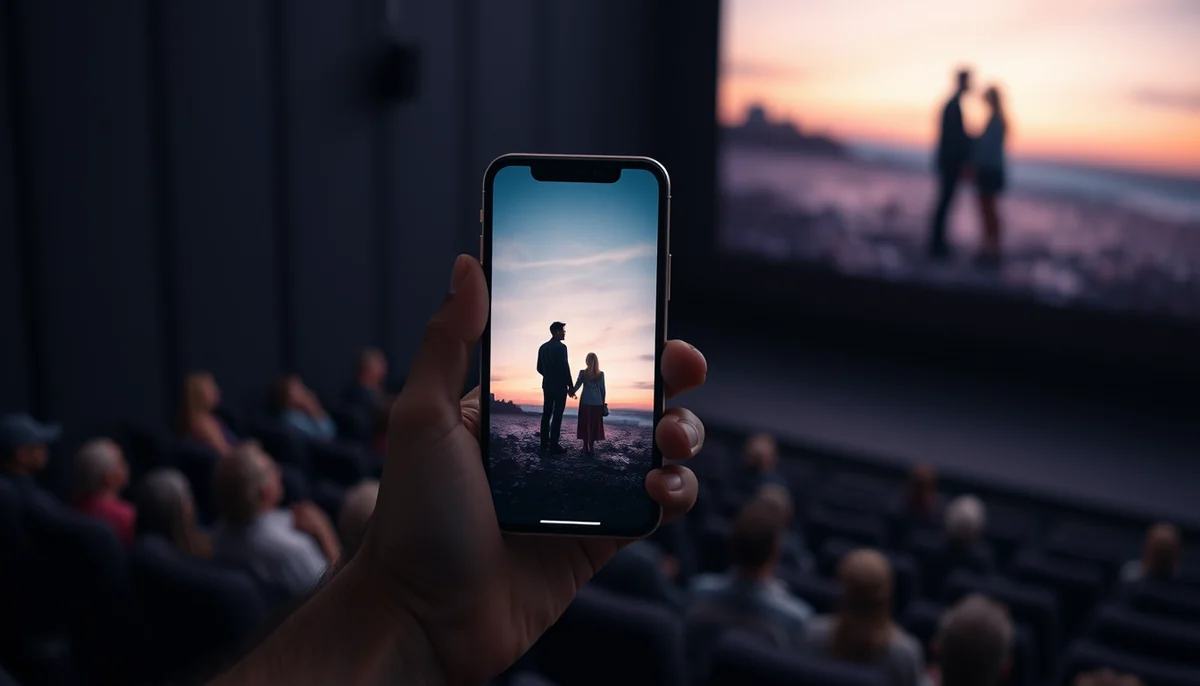
Context-aware conversion treats reframing as a compositional problem rather than a geometric one. It starts from what each shot is about, not from where the center of the frame is.
That means identifying the subject, relationship or action carrying the meaning, then building a vertical frame that keeps it. Where one vertical frame cannot hold what the horizontal frame held, the answer is not to throw information away but to reconstruct the shot so the narrative survives. In practice this involves tracking subjects through a shot, deciding which element leads when several compete, moving the frame with the action rather than chasing pixels, and keeping text legible and in place.
This is the approach behind Reframe, CineVision’s AI conversion system. Its principle is stated plainly on the product page: “We don’t pan and scan. We recreate.” Reframe converts between aspect ratios, including legacy 4:3, 480p TV shows to vertical 9:16 or OTT 16:9, up to 4K. It tracks and frames the subject automatically, and editors can steer a conversion with plain prompts such as “expand the sky” or “keep the dagger on frame at all times.” For series and features headed to short-form platforms, it also suggests where episode breaks and cliffhanger moments should fall.
AI handles the heavy lifting of frame reconstruction. People still decide what each scene is about and whether the result is right, which is why review is built into the process below.
Which titles make the best vertical films?
Not every title converts equally well, so selection comes before any conversion work. The table below is a practical starting point for triaging a catalogue.
| Material | Conversion difficulty | Why |
|---|---|---|
| Dialogue-driven drama, tight coverage | Lower | Singles and close shots already center on faces and performance |
| Two-handers and interviews | Lower to medium | Alternation between speakers maps well to vertical, but reactions need care |
| Legacy 4:3 TV series | Medium | Narrower source frame, but often low resolution that needs upscaling |
| Ensemble scenes | Higher | Several subjects compete for a narrow frame |
| Fast-cut action | Higher | Subject position must stay readable across rapid cuts |
| Scope epics built on wide vistas | Highest | Scale is the point of the image, and a 2.39:1 frame is the furthest from 9:16 |
A sensible approach is to pick a tranche of titles from the easier rows, convert them properly, measure how they perform and let that evidence guide the next tranche.
Scoping a catalogue conversion
Studios doing this for the first time usually underestimate the preparation and overestimate the conversion itself. Four things need answers before work starts.
Material condition. Conversion works best from the best available master. Titles that need restoration carry that cost first, and converting from a compressed delivery file stacks losses on losses.
Rights. Creating a new version of a work is an exploitation. Whether existing agreements permit derivative formats, and on which platforms, is a question for your rights audit rather than an assumption.
Creative sign-off. Someone with authority has to approve that the vertical version represents the work acceptably. Schedule that review; do not discover it at delivery.
Deliverables. The output is not just a vertical file. It is a vertical master with its own caption positioning, artwork ratios and metadata, and vertical surfaces have their own delivery requirements. A beautifully converted picture still fails QC if the captions were copied from the 16:9 version.
If the destination is short-form, there is one more editorial layer: deciding what counts as an episode, where it breaks and how it opens. A feature does not become a vertical series by being cut into equal lengths.
How to review a converted title
Conversion is a creative process, so it needs creative review. Productions that skip this find their problems at delivery.
- Test the hardest material first. Two or three minutes covering a multi-person scene, a wide and a sequence with on-screen text. If the approach works there, it will work on the rest.
- Review against the original, not in isolation. The question is not “is this a reasonable vertical video?” but “does this represent the film?” Side-by-side comparison surfaces losses that pass unnoticed on their own.
- Agree what acceptable loss looks like. Something is always lost. Deciding in advance what is tolerable prevents endless revisions and the opposite failure of accepting whatever arrives.
- Check on a phone. Reviewing on a large monitor misses problems with text size and subject scale.
For the comparison step, PeakView plays two versions in sync, including different aspect ratios, so reviewers can leave notes at the exact frame and timecode and resolve them in one place.
Key insight: The best reviewer for a converted title is often someone who knows the original well. They notice the missing reaction shot that a fresh viewer never knew was there.
Working with filmmakers and talent
For titles where relationships with the original filmmakers still matter, conversion touches sensitive ground. Directors and cinematographers composed those frames deliberately, and reframing their work without consultation is at least a relationship risk and, under some agreements, a contractual one. Check consultation obligations before work begins.
Early involvement usually improves the result. Filmmakers know what each shot was about better than any analysis can infer, and their input on which element leads in a difficult scene is valuable. Where they are unavailable, keep the standard conservative: preserve intent as far as it can be determined and avoid choices that change meaning rather than framing.
From library to vertical screens
Turning a catalogue into vertical film versions is a craft process with a technology label on it. The tools matter, but the decisions matter more: what each shot is about, which subject leads and what an acceptable loss looks like. Treat it that way, build review into the schedule, and a film shot for cinemas can work on a phone.
If you are weighing a first tranche, upload one title to Reframe and watch it convert. It is the fastest way to find out how your own material behaves in a vertical frame.